
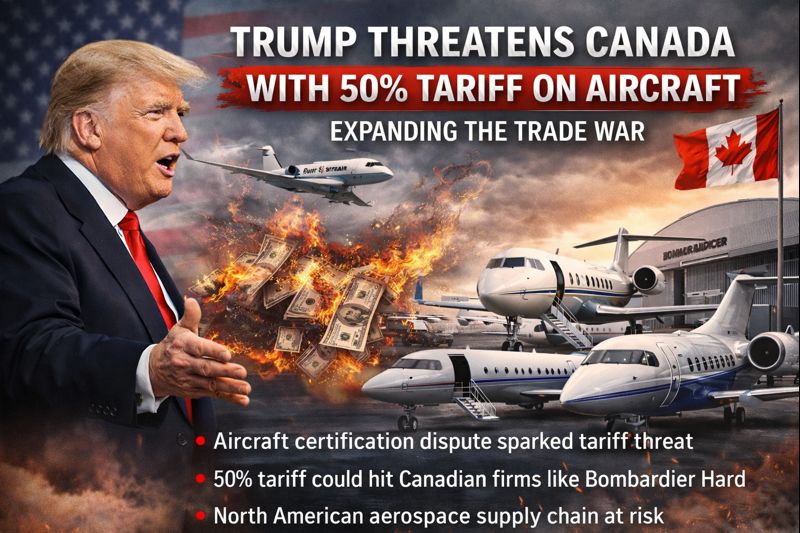
Trump Threatens Canada With 50% Tariff on Aircraft, Escalating Trade Tensions
The trade relationship between the United States and Canada—long regarded as one of the world’s most stable and cooperative—has once again come under pressure. Former U.S. President Donald Trump has threatened to impose a 50% tariff on Canadian-manufactured aircraft sold in the United States, a move that could sharply escalate trade tensions between the two neighboring nations.
This latest warning represents a significant expansion of Trump’s aggressive trade strategy, pulling the highly specialized aerospace industry into the center of an already strained economic relationship.
What Triggered the New Tariff Threat?
The immediate cause of the threat is a dispute over aircraft certification. Trump claims that Canadian aviation authorities have failed—or deliberately refused—to certify certain business jet models produced by Gulfstream Aerospace, a major U.S.-based aircraft manufacturer.
Aircraft certification is a technical process that determines whether an aircraft meets the safety and regulatory standards required to operate in a specific country. According to Trump, Canada’s actions unfairly disadvantage American manufacturers.
In response, he has warned that the United States could decertify Canadian-made aircraft and impose a steep 50% import tariff unless the issue is resolved quickly. This approach effectively turns a technical regulatory matter into a political and economic confrontation.
Why Aircraft Tariffs Matter So Much
The aerospace industry is unlike most others. Aircraft production relies on highly complex global supply chains, long-term contracts, and investments worth billions of dollars. Canada is a major global aerospace hub, home to manufacturers such as Bombardier and De Havilland, which produce business jets, regional aircraft, and turboprop planes widely used across the United States.
A 50% tariff would likely:
- Dramatically increase costs for U.S. buyers of Canadian aircraft
- Disrupt existing sales agreements and delivery schedules
- Put thousands of jobs at risk on both sides of the border
- Create uncertainty throughout the broader aerospace supply chain
Because aircraft purchases are planned years in advance, even the threat of tariffs can cause serious financial and logistical disruptions.
A Break From Long-Standing Trade Norms
Historically, civil aircraft have been treated differently in global trade disputes. Under international agreements, including those supported by the World Trade Organization (WTO), many countries have worked to reduce or eliminate tariffs on civil aircraft to promote cooperation, innovation, and safety.
Trump’s threat challenges this tradition. By linking regulatory certification decisions with trade retaliation, the U.S. risks blurring the line between aviation safety oversight and political pressure. Experts warn that this could undermine trust between regulators and potentially weaken global aviation safety standards.
Canada’s Stance and Possible Response
Canadian officials have responded cautiously. Ottawa maintains that aircraft certification decisions are made independently by Transport Canada, based strictly on technical and safety considerations—not political influence.
If the U.S. proceeds with tariffs, Canada has several potential options:
- Negotiation: Seek a technical resolution through diplomatic and regulatory talks
- Legal challenge: Contest the tariffs through international trade mechanisms
- Retaliation: Impose counter-tariffs on U.S. goods, as seen in past disputes
Given the aerospace sector’s economic importance, Canada is unlikely to yield easily to political pressure.
Impact on U.S. Businesses and Consumers
Although the tariffs target Canada, they could also harm U.S. companies and buyers:
- Airlines and private jet customers may face higher prices and fewer choices
- U.S. suppliers linked to Canadian manufacturers could see reduced demand
- Leasing firms and charter operators may delay purchases, slowing market growth
In practice, tariffs often function as a hidden tax—affecting domestic buyers as much as foreign producers.
Part of a Broader Trade Strategy
This threat fits a familiar pattern in Trump’s economic approach. Throughout his political career, he has relied heavily on tariffs and economic pressure to counter what he views as unfair trade practices. Steel, aluminum, automobiles, and now aircraft have all been targets.
By extending trade disputes into aviation, Trump is signaling that no industry is off-limits, even sectors traditionally shielded from political conflict due to safety and international cooperation concerns.
What Comes Next?
At present, the tariff remains a threat rather than an implemented policy. Its outcome will depend on several key factors:
- Whether Canada agrees to certify the disputed U.S. aircraft models
- Whether aviation regulators from both countries engage in technical discussions
- Whether political pressure leads to compromise—or further escalation
Industry leaders and financial markets are watching closely, as even the possibility of such tariffs has already introduced uncertainty into the aerospace sector.
Conclusion
Trump’s threat to impose a 50% tariff on Canadian aircraft sold in the United States marks a serious escalation in U.S.–Canada trade tensions. What began as a regulatory disagreement has evolved into a high-stakes economic confrontation involving one of the world’s most advanced and interconnected industries.
While the rhetoric is tough, both countries have strong incentives to avoid lasting damage. The aerospace industry depends on trust, cooperation, and shared standards—values that are difficult to rebuild once lost. Whether diplomacy prevails or the trade war deepens will shape not only U.S.–Canada relations, but also the future of global aviation trade.
Other posts: Fingers on the trigger, says Iran after Trump’s warning
1 thought on “U.S.–Canada Trade Rift Deepens as Trump Warns of 50% Tariff on Aircraft”