
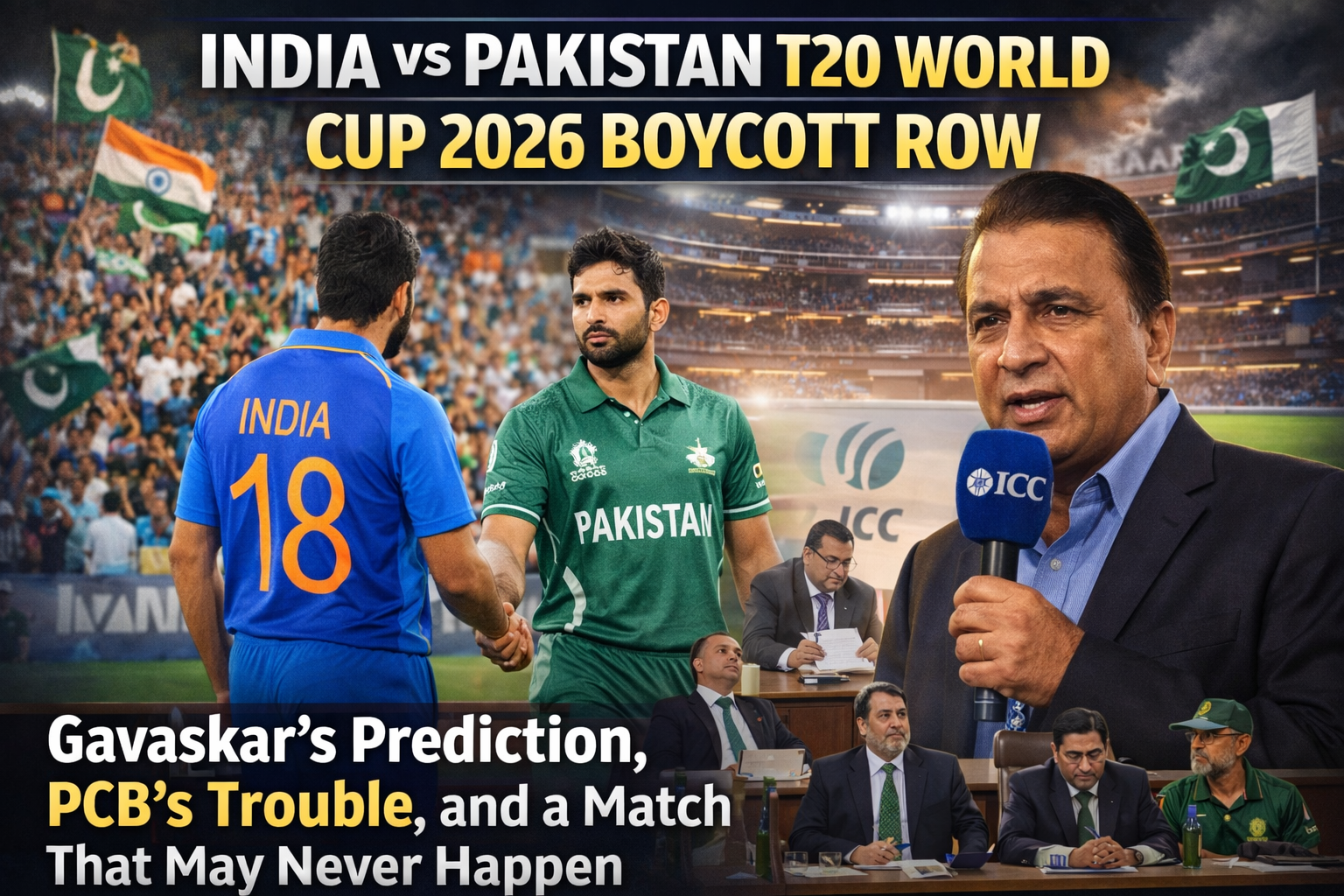
Few sporting rivalries in the world carry as much emotion, history, and tension as India vs Pakistan. It is not just about cricket. It never has been. And as the T20 World Cup 2026 approaches, that truth is once again impossible to ignore.
The latest controversy — a possible boycott, allegations of contract violations, and sharply worded reactions — has turned what should have been a celebration of cricket into a complicated political and administrative puzzle. At the heart of it all is a claim that the Pakistan Cricket Board has breached certain contractual commitments, triggering uncertainty around whether India will play Pakistan at all during the tournament.
Adding weight to the debate, former India captain Sunil Gavaskar has made a blunt prediction: India will not be forced to play Pakistan, no matter how big the match is or how much money is involved.
That statement alone has reshaped the conversation.
How Did This Situation Escalate?
This boycott row did not erupt overnight. It has been building quietly, shaped by unresolved bilateral tensions and fragile trust between cricket boards. While Board of Control for Cricket in India and the PCB do engage through ICC events, bilateral series have remained suspended for years.
According to reports, the current dispute revolves around alleged deviations from agreed terms related to hosting responsibilities, logistics, and guarantees tied to the ICC Men’s T20 World Cup 2026. While details remain murky, even the suggestion of a contract breach is enough to trigger alarm bells within the ICC framework.
For India, participation is not purely a cricketing decision. For Pakistan, hosting and full participation are matters of prestige and economic importance. Somewhere in between lies the ICC, trying to prevent the tournament from becoming collateral damage.
Sunil Gavaskar’s Words Carry Weight
When Sunil Gavaskar speaks, people listen — not because he is loud, but because he is measured. That is why his prediction has caused such a stir.
Gavaskar suggested that India will stick to its position, even if that means skipping a marquee match. In doing so, he challenged one of cricket’s most deeply held assumptions: that India vs Pakistan is “too big to fail.”
For decades, broadcasters, sponsors, and administrators have relied on this fixture to drive viewership and revenue. Gavaskar’s remarks imply that those financial realities may no longer be enough to override national policy and institutional caution.
Some fans applauded his stance, calling it realistic and principled. Others argued that cricket should not be held hostage to politics. The split reaction itself reflects how emotionally charged this rivalry has become.
PCB’s Response and the Contract Question
The PCB has strongly denied any wrongdoing. Officials insist that Pakistan remains fully committed to the tournament and that claims of contract violations are either exaggerated or misunderstood. From their perspective, the boycott narrative feels one-sided and unfair.
However, in global sports administration, perception matters almost as much as paperwork. Once the words “contract violation” enter the conversation, trust erodes quickly. If the International Cricket Council finds even partial fault, it could lead to sanctions or forced adjustments — outcomes no board wants.
ICC’s Tightrope Walk
For the ICC, this situation is a nightmare scenario. On one hand, it must uphold tournament rules and ensure equal treatment for all member nations. On the other, it cannot ignore the realities of geopolitics or the commercial importance of India.
If India is allowed to avoid playing Pakistan without consequences, it sets a precedent. If India is compelled to play, it risks backlash at home and potential player discomfort. There is no option that satisfies everyone.
This is why the ICC’s next steps will be watched closely — not just for this tournament, but for the future of international cricket governance.
What If the Match Doesn’t Happen?
A boycott would force the ICC to consider alternatives, none of them ideal:
- Walkover or points adjustment, which undermines sporting fairness
- Group reshuffling, creating logistical chaos
- Legal disputes with broadcasters and sponsors
- Long-term strain between member boards
Each scenario weakens the tournament in different ways. And yet, forcing the match could weaken the credibility of the ICC even more.
Fans: The Silent Casualties
Lost in boardroom negotiations are the fans — millions of them — who grow up watching this rivalry, waiting years for these encounters. For many, India vs Pakistan matches are shared memories, late nights, nervous excitement, and endless debates.
At the same time, public sentiment in India shows strong support for a cautious approach. Social media reactions suggest that a significant section of fans is willing to sacrifice a match if it aligns with national priorities.
That shift in mindset is telling. The rivalry may still be massive, but it is no longer unconditional.
A Rivalry That Reflects Reality
This episode underlines a simple truth: India vs Pakistan cricket mirrors real-world relations. When ties are tense, the sport feels it first. When diplomacy stalls, cricket follows.
The T20 World Cup 2026 was supposed to be about explosive batting, packed stadiums, and unforgettable moments. Instead, it has become a case study in how modern sport operates at the intersection of politics, commerce, and public opinion.
What Comes Next?
As of now, nothing is final. Discussions are ongoing, legal teams are involved, and the ICC is under pressure to find a workable solution. Gavaskar’s prediction may turn out to be accurate — or diplomacy may produce a compromise few expect.
Either way, one thing is clear: the India vs Pakistan match is no longer guaranteed simply because it is popular.
And that, more than any statement or allegation, marks a turning point in how global cricket navigates its most famous rivalry.