
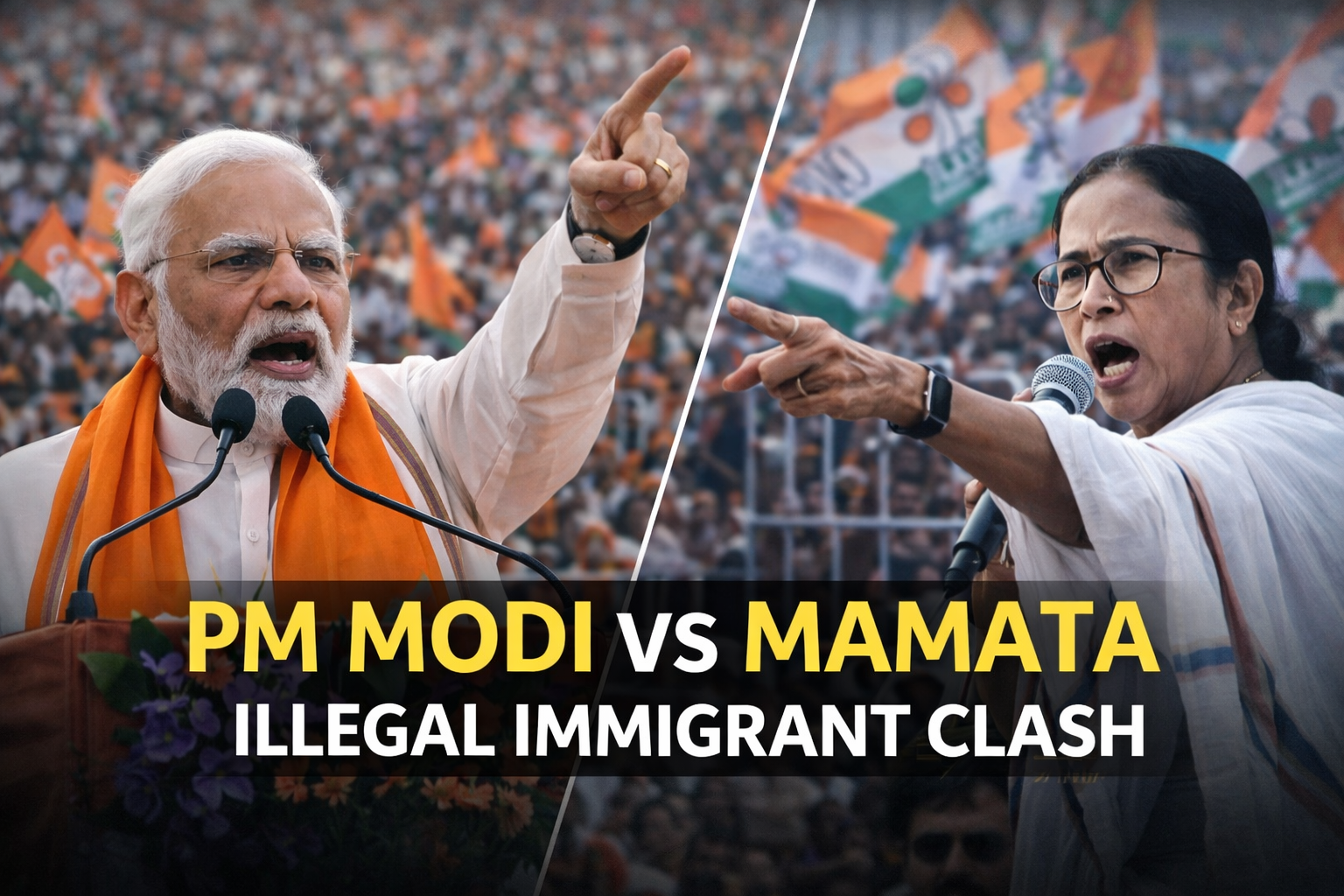
Indian politics thrives on strong words, but when those words touch issues like illegal immigration, national security, and constitutional authority, they carry far greater weight. That is exactly what happened when Narendra Modi launched a pointed attack on Mamata Banerjee, alleging that her party, the Trinamool Congress, is “going to court to protect illegal immigrants.”
The statement immediately triggered political reactions across the country. Supporters of the BJP hailed it as a bold stand on national security, while Trinamool leaders called it misleading and politically motivated. Beyond the shouting matches, however, lies a deeper story—one that mixes law, governance, electoral strategy, and public perception.
This controversy is not just about one speech or one allegation. It reflects a long-running political battle over immigration, identity, and power between the Centre and one of India’s most influential regional leaders.
What PM Modi Actually Alleged
Speaking at a public rally, PM Modi accused the Trinamool Congress of opposing action against illegal immigrants by challenging such measures in court. His claim suggested that instead of supporting enforcement agencies, the West Bengal government is actively obstructing them through legal means.
The message was clear and deliberately simple:
According to PM Modi, Trinamool is prioritising vote-bank politics over the rule of law.
In Indian political communication, simplicity is strength. The allegation was framed in a way that ordinary voters could easily understand, even if the legal realities behind it are far more complex.
Why Immigration Is a Sensitive Issue in West Bengal
West Bengal occupies a unique position in India’s immigration debate. The state shares a long and porous border with Bangladesh, and cross-border movement has been happening for decades due to historical, economic, and humanitarian reasons.
Over the years, this has raised difficult questions:
- Who is a legal migrant?
- Who qualifies as a refugee?
- Who is an illegal immigrant?
- How should identification and deportation be handled fairly?
Different governments have offered different answers. The BJP has consistently pushed for strict documentation, enforcement, and identification, framing illegal immigration as a threat to national security and public resources. Trinamool Congress, on the other hand, has often highlighted humanitarian concerns and warned against actions that could target genuine citizens or minorities.
PM Modi’s accusation strikes directly at this ideological fault line.
The “Going to Court” Argument: Law vs Politics
One of the most controversial aspects of PM Modi’s statement is the implication that approaching courts is somehow illegitimate. In reality, courts are a fundamental part of India’s constitutional framework. Governments and political parties regularly challenge laws, notifications, and administrative actions in court.
However, Modi’s criticism is not about legality—it is about intent.
By saying Trinamool is going to court to protect illegal immigrants, he implies that:
- Legal challenges are being used as political tools
- Enforcement agencies are being deliberately slowed down
- The state government is shielding illegal activity
This framing transforms a legal disagreement into a moral and national one, which is far more powerful in electoral politics.
Mamata Banerjee’s Leadership Image Under Fire
Mamata Banerjee has long cultivated the image of a fierce, independent leader who stands up to the Centre. For her supporters, she is:
- A defender of federalism
- A protector of minority rights
- A leader who resists what she calls “central overreach”
For her critics, however, she represents:
- Appeasement politics
- Weak enforcement of border controls
- Administrative leniency for political gains
PM Modi’s attack feeds directly into the second narrative. By framing Trinamool’s legal actions as protection for illegal immigrants, he challenges Mamata’s credibility not just as a state leader, but as a responsible administrator.
BJP vs Trinamool: Competing Narratives
At its core, this confrontation is about two very different political worldviews.
BJP’s Position
- Strong borders are essential for national security
- Illegal immigration strains public resources and jobs
- Laws must be enforced uniformly across states
- Any party blocking enforcement is acting against national interest
Trinamool’s Position
- Immigration issues are complex and sensitive
- Blanket actions risk harassing genuine citizens
- Legal safeguards are necessary to prevent injustice
- The Centre uses agencies and rhetoric for political pressure
PM Modi’s statement is designed to simplify this debate for voters, reducing it to a binary choice: law and order versus appeasement.
Why This Message Resonates With Voters
Illegal immigration is not an abstract policy issue for many Indians. It is linked—rightly or wrongly—to everyday concerns such as:
- Job competition
- Access to welfare schemes
- Local demographics
- Cultural identity
By accusing Trinamool of protecting illegal immigrants, PM Modi positions the BJP as the party of firmness and national interest. This messaging has worked effectively for him in the past, especially during election campaigns.
The language is emotional, direct, and confrontational—qualities that travel fast through rallies, television debates, and social media.
Political Timing and Electoral Calculations
The timing of this attack is also important. With elections approaching, sharpening the contrast between the BJP and regional parties is a strategic necessity.
For the BJP, the goal is clear:
- Nationalise state-level issues
- Portray regional leaders as obstacles to national priorities
- Consolidate support around security and governance themes
For Trinamool, the challenge is to counter this narrative without appearing defensive or dismissive of genuine public concerns.
Legal Reality vs Public Perception
It is important to note that going to court does not automatically mean defending illegal activity. Many cases involve due process, documentation errors, and constitutional protections.
But politics rarely operates on legal nuance. Perception often outweighs procedure, and PM Modi’s statement is crafted to influence perception decisively.
In the court of public opinion, the allegation itself can be as powerful as proof.
Broader Implications Beyond West Bengal
This controversy is not confined to one state. Immigration debates are intensifying across India, particularly in border regions and urban centres with large migrant populations.
By making West Bengal a focal point, PM Modi sends a broader message to other regional parties: resistance to central policies on immigration will be met with direct political confrontation.
Final Thoughts: More Than Just a Political Attack
PM Modi’s allegation that Trinamool is going to court to protect illegal immigrants is more than a campaign soundbite. It is a calculated political move aimed at redefining the immigration debate in moral and national terms.
For BJP supporters, it reinforces the image of decisive leadership.
For Trinamool supporters, it feels like an oversimplification meant to polarise voters.
As India moves closer to elections, such rhetoric is likely to intensify. What remains to be seen is whether voters will respond more to emotional messaging—or to the complex realities that lie ben