
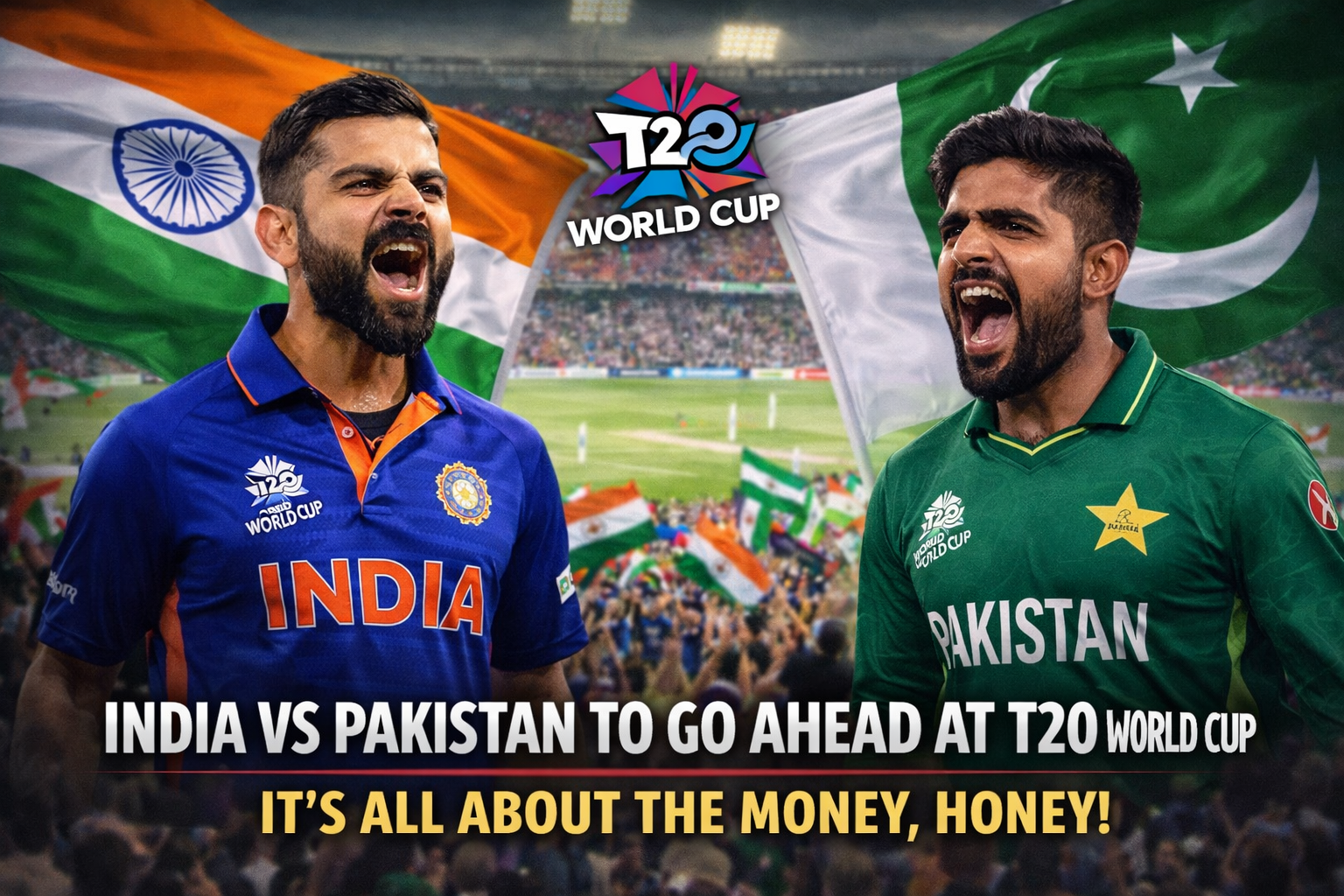
Let’s be honest for a moment. Strip away the patriotic speeches, the political noise, the moral debates, and the “national interest” arguments — and the reason India vs Pakistan is going ahead at the T20 World Cup becomes crystal clear.
It’s the money. Big money. Unavoidable money.
Cricket administrators may dress it up as “sporting tradition” or “fans deserve the contest,” but behind closed doors, the logic is brutally simple: no India–Pakistan match means a financial disaster for world cricket.
That is why, once again, the fiercest rivalry in the sport will take centre stage at the ICC T20 World Cup.
The Rivalry That Pays Everyone’s Bills
There is no fixture in global cricket that comes close to India vs Pakistan — not the Ashes, not World Cup finals, not franchise derbies.
When India plays Pakistan, the numbers explode:
- Television ratings spike across continents
- Advertising slots sell out in minutes
- Streaming platforms see record subscriptions
- Stadium tickets vanish instantly
For broadcasters, this single match can generate more revenue than several knockout games combined. For sponsors, it is a once-in-a-tournament jackpot.
And for the International Cricket Council (ICC), it is the financial backbone of the entire event.
Politics Stops at the Boundary Rope
Publicly, cricket boards often take strong political positions. Bilateral series are cancelled. Statements are issued. Tempers flare.
But ICC tournaments operate under a different reality.
The ICC is not in the business of diplomacy. It is in the business of selling cricket as a global entertainment product. And nothing sells like India vs Pakistan.
Quietly, administrators on all sides understand this:
- The Board of Control for Cricket in India (BCCI) earns massive broadcasting leverage
- The Pakistan Cricket Board (PCB) depends heavily on ICC revenue
- The ICC itself relies on this match to balance its books
Remove India–Pakistan, and the commercial model wobbles.
Why This Match Is ‘Too Big to Cancel’
Let’s imagine, hypothetically, that the match didn’t happen.
Broadcasters would demand refunds. Advertisers would renegotiate contracts. Ticket sales would dip. Smaller cricket nations would feel the financial shock because ICC revenues are shared.
In short, world cricket would pay the price — not just India or Pakistan.
That is why, no matter how loud the political noise becomes, ICC events always find a way to keep this fixture alive.
Morality is debated in press conferences. Money is discussed in boardrooms.
Guess which one decides the schedule?
Fans Are Part of the Business Equation
It’s easy to forget this, but fans play a huge role — knowingly or not.
Millions of viewers who claim to oppose the match still tune in. Social media explodes. Memes flood timelines. Hashtags trend globally. Even neutral fans watch, because the tension is addictive.
The rivalry has become a global spectacle, not just a bilateral contest.
Cricket administrators didn’t invent this demand — they simply monetised it.
T20 Format: Maximum Drama, Maximum Cash
There’s another reason this clash is especially valuable in a T20 World Cup.
T20 cricket is short, explosive, and unpredictable. One over can flip a match. One player can become a hero or villain.
That volatility is perfect for:
- Prime-time TV
- Casual viewers
- Advertisers chasing instant attention
An India–Pakistan Test match builds slowly. A T20 clash hits like a thunderbolt.
From a commercial point of view, it’s the ideal product.
The Hypocrisy Everyone Pretends Not to See
Here’s the uncomfortable truth.
Bilateral cricket between India and Pakistan is deemed “too sensitive.” But ICC matches are suddenly “pure sport.”
The distinction is convenient — and deeply political in itself.
Yet both boards accept it because:
- Walking away costs money
- Playing earns money
- Everyone benefits financially
So the match goes ahead, wrapped in national flags and emotional commentary, while accountants quietly smile.
Does This Harm the Spirit of Cricket?
Some argue yes. Others shrug.
Cricket has long moved beyond being just a sport. It is an entertainment industry, and India–Pakistan is its most profitable asset.
The ICC’s responsibility, in its own view, is not to solve geopolitical disputes — but to ensure tournaments succeed commercially.
From that perspective, the decision makes perfect sense.
What This Means for the Future
Don’t expect this to change anytime soon.
As long as:
- India remains cricket’s biggest market
- Pakistan remains central to the rivalry narrative
- Broadcasters keep paying record sums
India vs Pakistan will remain a non-negotiable fixture at World Cups.
The language around it may change. The justifications may evolve. But the underlying reason will stay the same.
The Bottom Line
India vs Pakistan at the T20 World Cup isn’t about goodwill, peace, or even cricketing necessity.
It’s about economics.
It’s about television rights, sponsorship deals, advertising revenue, and global eyeballs.
In modern cricket, ideals may set the tone — but money sets the schedule.
And when it comes to this rivalry, the message from the top is loud and clear:
It’s all about the money, honey.