
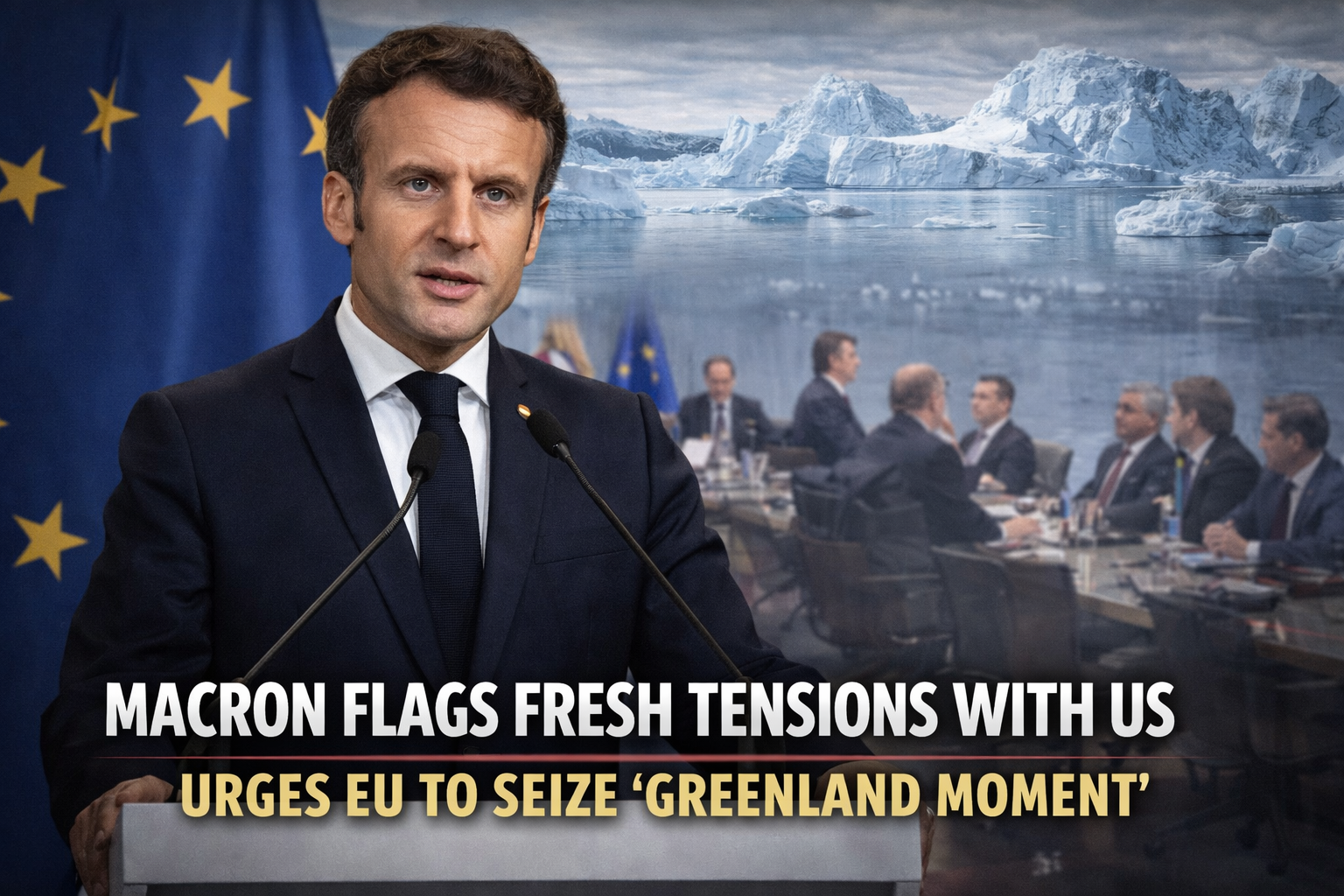
Brussels: French President Emmanuel Macron has warned that fresh tensions between the European Union and the United States are emerging, calling on Europe to seize what he described as a decisive “Greenland moment” to strengthen its economic and strategic independence.
Speaking ahead of key European meetings, Macron made it clear that the current lull in transatlantic friction should not be mistaken for long-term stability. Relations with Washington, he said, remain vulnerable to sudden shifts — and Europe must be ready.
“This is a moment of truth for Europe,” Macron said, according to remarks carried by European media. “If we do not act now, we will continue to depend on decisions taken elsewhere.”
A Warning Europe Cannot Ignore
Macron’s comments come at a sensitive time for the European Union, as leaders prepare to debate competitiveness, industrial policy, and the bloc’s future role in a rapidly changing global order.
While the EU and the United States remain close allies, Macron cautioned that political uncertainty, trade disputes, and strategic disagreements are once again putting pressure on the relationship.
His message was blunt: Europe cannot afford complacency.
What Is the ‘Greenland Moment’?
Macron used the phrase “Greenland moment” to describe a broader geopolitical wake-up call. The reference points to recent episodes in which US actions and rhetoric exposed Europe’s limited influence over decisions affecting its own strategic environment.
For Macron, Greenland symbolises a moment when Europe realised that even trusted partners may act unilaterally when their interests shift.
“This is not about hostility,” he stressed. “It is about lucidity.”
In practical terms, Macron is arguing that Europe must reduce its dependence — not only on the US, but on all external powers — in areas critical to its future.
Economic Sovereignty at the Centre
At the core of Macron’s warning is a renewed push for economic sovereignty.
He wants the EU to move faster on:
- Building strong European industrial champions
- Investing jointly in clean energy, defence, and advanced technology
- Reducing reliance on foreign supply chains
- Strengthening the EU single market
Macron has long supported common European borrowing to fund these goals. Now, he believes rising global tensions make such steps unavoidable rather than optional.
“Either Europe invests together, or it will fall behind together,” one senior European diplomat said, summarising Macron’s position.
Why the US Matters — But Isn’t the Only Factor
Although the warning focuses on the US, Macron made clear that Europe faces pressure from multiple directions.
China’s trade practices, state subsidies, and technological ambitions are reshaping global competition. Meanwhile, Washington’s industrial policies increasingly prioritise domestic production, sometimes at Europe’s expense.
Macron’s argument is that Europe must stop reacting case by case — and instead build long-term resilience.
Divided Reactions Inside Europe
Macron’s remarks have already triggered debate across EU capitals.
Some leaders agree that Europe must act boldly, arguing that repeated crises have exposed structural weaknesses in EU decision-making and investment capacity.
Others remain cautious, particularly around joint debt and large-scale spending commitments. They fear backlash from domestic voters and financial markets.
Yet even critics acknowledge that Macron’s warning reflects growing unease about Europe’s global position.
A Shift in Tone, Not Just Policy
What stands out this time is not just Macron’s message — but his tone.
This was not a theoretical speech about Europe’s future. It was a political alert, delivered with urgency and framed around real-world risks.
The implication is clear: Europe may not get many more chances to act on its own terms.
Global Implications
If Macron’s call gains traction, the consequences could extend far beyond Brussels.
A more assertive EU could:
- Reshape global trade rules
- Challenge US and Chinese dominance in key technologies
- Play a stronger role in global climate and security policy
For Washington, this could mean dealing with a Europe that is more independent — and occasionally more demanding.
The Bottom Line
Macron’s warning about renewed tensions with the US is not a declaration of confrontation. It is a call for preparedness.
In a world defined by competition and uncertainty, alliances alone are no longer enough. Power, Macron argues, comes from capacity — the ability to invest, decide, and act independently when necessary.
Whether Europe seizes this “Greenland moment” — or lets it pass — may determine its influence in the decades ahead.