
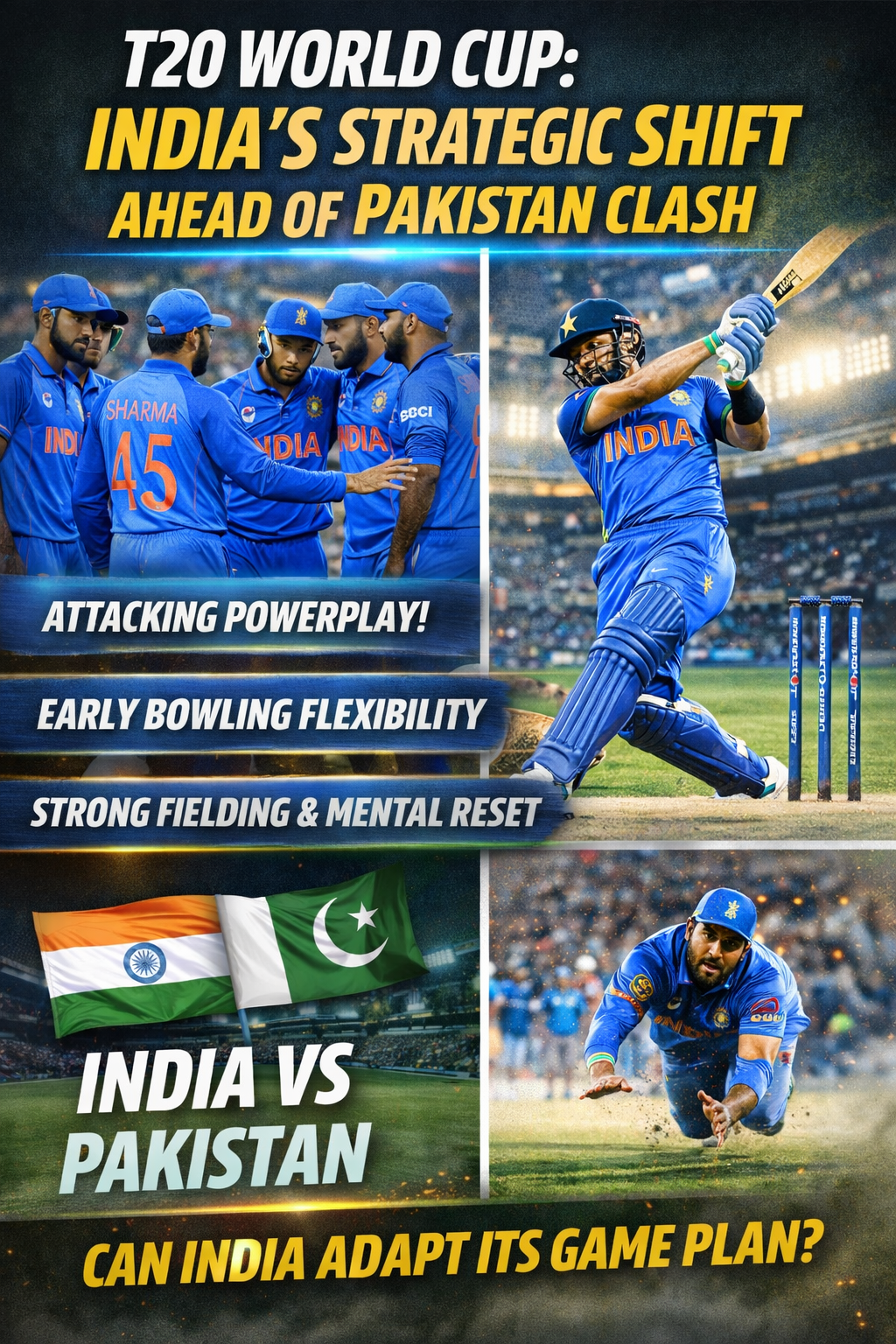
T20 World Cup: India’s Strategic Shift Ahead of Pakistan Clash
When India prepares for a Pakistan match in a T20 World Cup, it’s never routine. It’s never just another fixture circled on the calendar. Instead, it becomes a layered conversation — about tactics, temperament, selection calls, and above all, timing.
This time, however, there’s something slightly different in the air.
India isn’t just preparing for Pakistan. India appears to be adjusting its overall T20 identity — and that shift could define the contest.
A Move Away from Safe Cricket
For years, India’s T20 template in high-pressure matches relied heavily on stability at the top. The idea was simple: avoid early collapse, build partnerships, and accelerate later.
However, modern T20 cricket has evolved.
Powerplays now determine tone. Strike rate often outweighs longevity. Consequently, teams that hesitate early frequently end up chasing the game.
India seems to have recognized this shift.
Instead of purely anchoring, the approach now appears more proactive. Top-order batters are being encouraged to attack match-ups early. Bowlers are being rotated more aggressively. Field placements look sharper and more anticipatory.
In short, India seems ready to dictate phases rather than react to them.
Powerplay Intent: Setting the Tone
Against Pakistan, the first six overs are not just overs — they are psychological markers.
If India dominates early with the bat, Pakistan’s bowlers are forced onto defensive lines. Conversely, if India strikes early with the ball, the pressure multiplies quickly.
Therefore, the new emphasis appears clear: maximize the powerplay, whether batting or bowling.
Batters are looking to take calculated risks instead of waiting for “perfect” deliveries. Meanwhile, bowlers are focusing on attacking stumps and using variations early instead of saving them for the death.
That small tactical tweak could become decisive.
Bowling Flexibility: The Hidden Adjustment
India’s bowling strategy also seems to be evolving.
Traditionally, teams save their best overs for the death. However, against Pakistan, early breakthroughs often matter more than late containment.
As a result, India is experimenting with using key bowlers earlier in the innings. This disrupts rhythm and forces Pakistan’s top order to adjust faster than they’d prefer.
Moreover, variation has become central.
Slower balls, cross-seam deliveries, and wide yorkers are being used unpredictably. That unpredictability, in high-stakes matches, becomes a weapon.
Fielding: The Silent Game-Changer
T20 World Cups aren’t just about boundaries. They’re about moments.
A direct hit.
A diving catch.
A saved boundary.
India has quietly placed enormous emphasis on athletic fielding. In tight matches, those five to ten saved runs can become the margin between celebration and regret.
Against Pakistan — where pressure builds with every dot ball — sharp fielding adds to the squeeze.
Mental Reset: Playing the Situation, Not the Occasion
India’s biggest evolution might not be technical. It might be psychological.
Instead of framing the Pakistan game as a “battle of history,” the focus seems to be on situational awareness.
Play the conditions.
Play the match-ups.
Ignore the noise.
That mental simplification matters. When players focus only on controllable factors — length of delivery, field placement, strike rotation — the external pressure fades into the background.
And in India-Pakistan games, reducing emotional noise is half the victory.
Batting Depth: Insurance Policy
India’s strategic shift also includes batting depth.
All-rounders are being positioned carefully. Lower-order hitters are being trusted with clearer roles. Consequently, the middle order can attack without fear of collapse.
This layered batting structure creates freedom.
When players know there’s backup, they commit fully to their shots. That freedom often translates into bigger totals.
Pakistan Factor: Respect Without Fear
India’s approach signals something subtle yet powerful — respect Pakistan’s talent, but don’t play cautiously because of it.
That balance is critical.
Over-respect can create hesitation. Underestimating can create complacency. India appears to be navigating that line carefully.
The aim seems simple: stay disciplined, but stay aggressive.
Final Thoughts: A Calculated Evolution
T20 cricket is no longer about playing safe for 15 overs and exploding for five. It’s about constant pressure. Constant adaptation.
India’s preparation ahead of this Pakistan clash suggests awareness of that reality.
More intent in the powerplay.
More bowling flexibility.
Sharper fielding.
Calmer mental framing.
If this strategic shift translates onto the field, the upcoming encounter may not just be about rivalry — it could be about which team adapts better to the modern T20 blueprint.
And in tournaments like the T20 World Cup, adaptation often decides destiny.