
Overview: What Happened
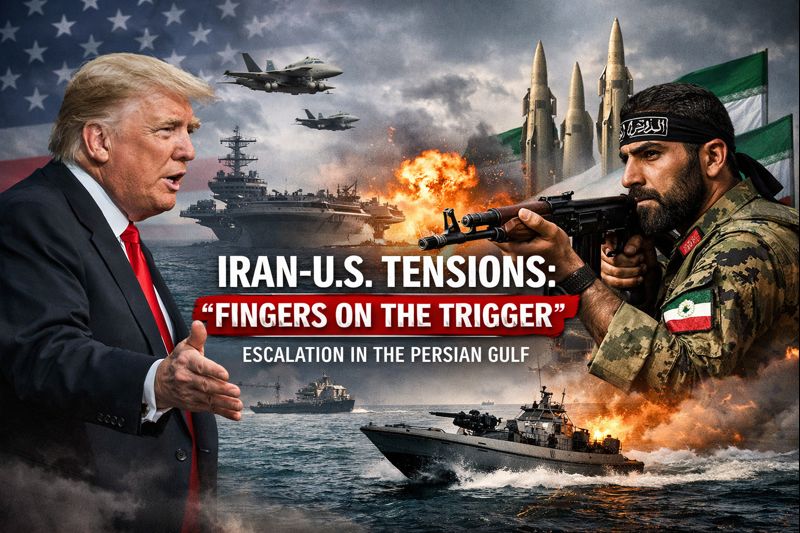
On January 28–29, 2026, U.S. President Donald Trump issued a stark ultimatum to Iran, urging it to agree to a new nuclear deal or face serious military consequences. Trump declared that “time is running out” for negotiations and hinted that a renewed U.S. military strike could be “far worse” than past actions, signaling a significant escalation in rhetoric and posture.
In direct response, Iran’s top officials warned that its armed forces are prepared — with their “fingers on the trigger” — to immediately and forcefully retaliate against any U.S. attack, further intensifying tensions between the two nations.
This confrontation marks one of the most serious diplomatic and military escalations in years between Washington and Tehran, with implications for Middle Eastern stability and global diplomacy.
Trump’s Warning: Deal or Danger
Trump’s message was blunt and public. On social media and in statements to the press, he reiterated that Iran must negotiate a new nuclear deal — one that prevents the development of nuclear weapons — and that failure to do so could trigger U.S. military action.
He highlighted the deployment of what he called a “massive armada” of U.S. naval forces — including the aircraft carrier USS Abraham Lincoln — to waters near Iran. Trump stressed that the fleet was more formidable than previous deployments and was ready “with speed and violence, if necessary.”
According to these statements:
- Trump framed the military buildup as both a signal of strength and as leverage to bring Iran back to the bargaining table.
- He claimed previous attacks had not achieved lasting results and warned that future action would be significantly more intense.
This approach reflects a broader U.S. policy perspective: combining diplomacy with the credible threat of force to curb Iran’s contentious nuclear activities — which many Western governments see as a pathway to weapons capability.
Iran’s Response: Readiness and Warning
Iran’s reply came swiftly. Foreign Minister Abbas Araghchi and other senior officials posted messages emphasizing that Iranian forces were poised to defend the nation, with “fingers on the trigger” ready to respond to any U.S. attack.
Key elements of Iran’s response include:
- Explicit Military Readiness
Iran declared that its armed forces would “immediately and powerfully respond” to any aggression against its territory — whether by land, sea, or air. This direct language signals a readiness to escalate militarily if attacked. - Use of Recent Military Experience
Iranian officials referenced lessons learned from the 12-day conflict with Israel last year, suggesting that Tehran now believes it can deliver a stronger, faster, and more decisive defense if provoked. - Conditional Diplomacy
Despite the strong military rhetoric, Tehran did not completely dismiss the possibility of diplomacy. Araghchi reiterated that Iran would welcome a “mutually beneficial, fair and equitable nuclear deal” that respects Iran’s right to peaceful nuclear technology and avoids coercion. - Warnings Beyond the U.S.
An adviser to Iran’s Supreme Leader took a harsher tone, warning that any attack — even a limited one — would be considered the start of war and could draw in Iran’s broader regional partners, potentially including actions against U.S. allies.
Diplomacy in Crisis: Negotiations and Conditions
Even as tensions rise, there are stark differences in how each side sees diplomacy:
- United States: Trump insists that Iran must commit to a deal limiting its nuclear program, throwing the weight of U.S. military force and economic pressure behind this demand. The U.S. position links diplomatic progress to Iran curbing its nuclear capabilities.
- Iran: Tehran insists that negotiations can only be meaningful if conducted on an equal footing free of threats or coercion. Iranian lawmakers and diplomats — including the Parliament Speaker — have stated that they would negotiate only under genuine conditions, not under duress.
This impasse underscores a fundamental diplomatic disconnect: Washington wants verifiable limits on Iran’s nuclear activities, while Tehran seeks recognition of its rights and security without conditions it views as ultimatums.
Regional and International Reactions
The situation has triggered responses beyond Tehran and Washington:
- European Union: The EU is moving to designate Iran’s Islamic Revolutionary Guard Corps (IRGC) as a terrorist organization in response to Tehran’s crackdown on internal protests, attaching new sanctions and adding pressure on the Iranian regime.
- Global Powers: Russia has called for renewed dialogue between the U.S. and Iran and warned against resorting to force, arguing that military confrontation could destabilize the broader Middle East.
- Regional Allies: Many Middle Eastern states are watching closely, concerned that conflict between the world’s largest military (the U.S.) and a major regional power (Iran) could ignite wider hostilities involving militias and allied groups across Iraq, Syria, Yemen, and Lebanon.
Underlying Context: Why This Matters
The current standoff doesn’t occur in isolation. Tensions between Iran and the United States have been building for years, shaped by:
- Iran’s nuclear program: Tehran’s enrichment activities — which Western powers fear could lead to weapons — have long been the crux of diplomatic disputes.
- Military confrontations: Past U.S. strikes on Iranian infrastructure and proxy conflicts throughout the Middle East have deepened mistrust.
- Domestic pressures in Iran: Widespread protests and severe government crackdowns have weakened the regime’s internal legitimacy, complicating diplomatic calculations on all sides.
These factors mean that both diplomatic outreach and military signaling are occurring amid a highly charged domestic and international environment, where miscalculation could have severe consequences.
Potential Paths Forward
At this tense moment, there are a few possible scenarios:
- Diplomatic De-escalation:
If both sides find a way to compromise — perhaps through intermediaries or third-party mediators — talks could resume, averting military confrontation. - Limited Military Skirmishes:
A misinterpreted move or localized clash at sea or in contested airspace could trigger a broader exchange of force. - Full-Scale Conflict:
The most dangerous outcome would be a deliberate military strike by the U.S., met with a comprehensive Iranian response — fulfilling Tehran’s warning of retaliation with its “fingers on the trigger.”
Conclusion: A Critical Juncture
The exchange of warnings between President Trump and Iranian leaders marks a critical escalation in an already fragile relationship. While both sides have publicly acknowledged the possibility of a fair nuclear deal, the shadow of military confrontation looms large, with Iran asserting readiness to defend itself vigorously and the U.S. signaling an increased willingness to use force if diplomacy fails.
The international community now faces the challenge of balancing deterrence with dialogue — navigating a path that prevents conflict, respects diplomatic avenues, and addresses deep-rooted strategic disagreements between two powerful and distrustful rivals.
Other posts: Budget Session 2026-27
1 thought on “Fingers on the trigger, says Iran after Trump’s warning”