
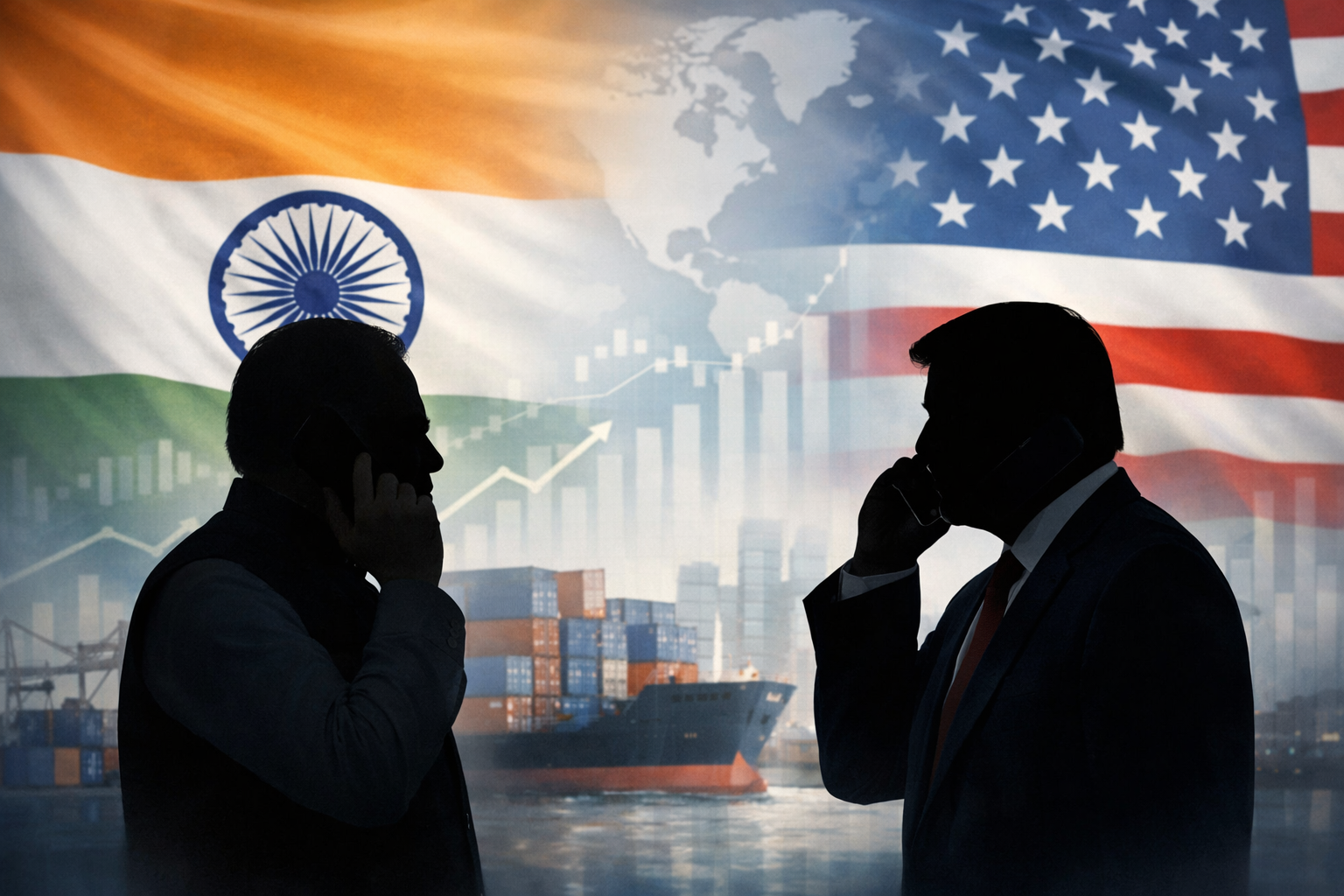
When headlines screamed that India and the United States were eyeing a $500 billion trade promise after a phone call between Donald Trump and Narendra Modi, it sounded historic. Social media lit up, markets reacted, and political camps on both sides claimed victory. But once the noise settled, a bigger question emerged: was this a transformational trade breakthrough, or was it mostly political theatre wrapped in big numbers?
To answer that, we need to look beyond the headline and understand what actually changed after the Trump–Modi call—and what remains more symbolism than substance.
The Context: A Relationship That Needed Resetting
India–US trade ties have always been a mix of opportunity and friction. While the two countries call each other “strategic partners,” trade disputes over tariffs, market access, and geopolitical alignments have repeatedly strained the relationship. During Trump’s earlier presidency, India lost preferential trade status, faced higher tariffs, and was publicly criticised for buying Russian oil.
Against that backdrop, the recent Trump–Modi conversation was not just a courtesy call. It was a reset attempt, driven by mutual needs. The US wants India firmly in its geopolitical camp, while India wants stable access to the American market without unpredictable tariff shocks.
What Was Actually Announced After the Call
The most concrete outcome of the Trump–Modi call was tariff-related—not a massive trade cheque.
The United States indicated it would lower tariffs on several Indian exports, bringing them down to an average of around 18 percent. This matters because earlier tariff levels, combined with punitive duties, had made many Indian goods less competitive in the US market. For exporters in textiles, engineering goods, auto components, and select manufactured products, this change has immediate commercial value.
Another key shift was the rollback of punitive measures linked to India’s purchase of Russian crude oil. While India has not formally committed to stopping Russian oil imports overnight, it has signaled a willingness to diversify energy sourcing. This diplomatic flexibility helped ease pressure from Washington.
These moves are real, measurable, and policy-driven—not just talk.
So Where Did the $500 Billion Figure Come From?
Here’s where the optics begin to outweigh the paperwork.
The $500 billion number did not emerge from a signed trade agreement or a joint legal framework. Instead, it came from political statements, largely framed as a long-term ambition rather than a binding commitment.
To put this in perspective:
- India’s total imports from the US are nowhere near $500 billion today.
- Reaching that figure would require many years, possibly decades, of steady trade growth.
- There is no published timeline, sector-wise breakdown, or enforcement mechanism attached to the figure.
In simple terms, the $500 billion promise is aspirational, not contractual. It reflects a vision of what India–US trade could become, not what has been legally agreed upon today.
Why Politicians Love Big Trade Numbers
Large trade figures serve a purpose—especially in politics.
For Trump, the narrative is clear: he can claim that tough diplomacy forced India to open markets and commit to buying American goods. For Modi, the optics are equally useful: India is portrayed as a respected global player negotiating as an equal with the world’s largest economy.
But from a policy standpoint, ambition without structure is not a deal. Until details like product categories, procurement commitments, timelines, and dispute mechanisms are released, the $500 billion figure remains more of a headline amplifier than an economic roadmap.
What Changed for India on the Ground
Despite the hype, Indian businesses should not dismiss the deal as meaningless.
The tariff reductions alone improve certainty for exporters who were struggling with volatile US trade policy. Lower duties mean better pricing, improved margins, and renewed confidence in planning long-term contracts.
Strategically, the deal also signals that India is not isolated. At a time when global trade is fragmenting and protectionism is rising, maintaining smoother access to the US market gives India leverage—especially as it simultaneously deepens trade ties with Europe and other regions.
However, sensitive sectors like agriculture and dairy remain politically protected in India. Despite US claims of wider market access, New Delhi has been careful not to commit publicly on areas that could trigger domestic backlash.
What the US Gains From This Arrangement
From Washington’s perspective, the deal strengthens India’s role as a counterweight to China. Reducing trade friction keeps India economically aligned with the West, while energy discussions reduce India’s dependence on Russian oil over time.
The US also benefits symbolically. Even without a signed $500 billion contract, the perception of expanded trade reinforces America’s image as a central player in global commerce.
Substance vs Symbolism: A Clear Divide
So what’s real, and what’s still political packaging?
Substance
- Reduction in US tariffs on Indian exports
- Removal of punitive trade measures
- Improved short-term trade certainty
Symbolism
- The $500 billion trade promise
- Claims of zero barriers without detailed documentation
- Long-term purchase commitments without timelines
Both matter—but they are not the same thing.
The Bottom Line
The Trump–Modi call did not magically rewrite India–US trade relations, but it did cool tensions and restore a degree of predictability. That alone is valuable in today’s unstable global economy.
However, the much-publicised $500 billion promise is best viewed as political optics, not a signed economic revolution. Until formal agreements, detailed frameworks, and binding commitments emerge, the number remains a vision—not a guarantee.
In short, this was a tactical win, not a transformational leap. Real change will depend on what happens next, not what was said on the phone.
1 thought on “India–US Trade Deal: $500 Billion Promise or Political Optics? What Really Changed After the Trump–Modi Call”