
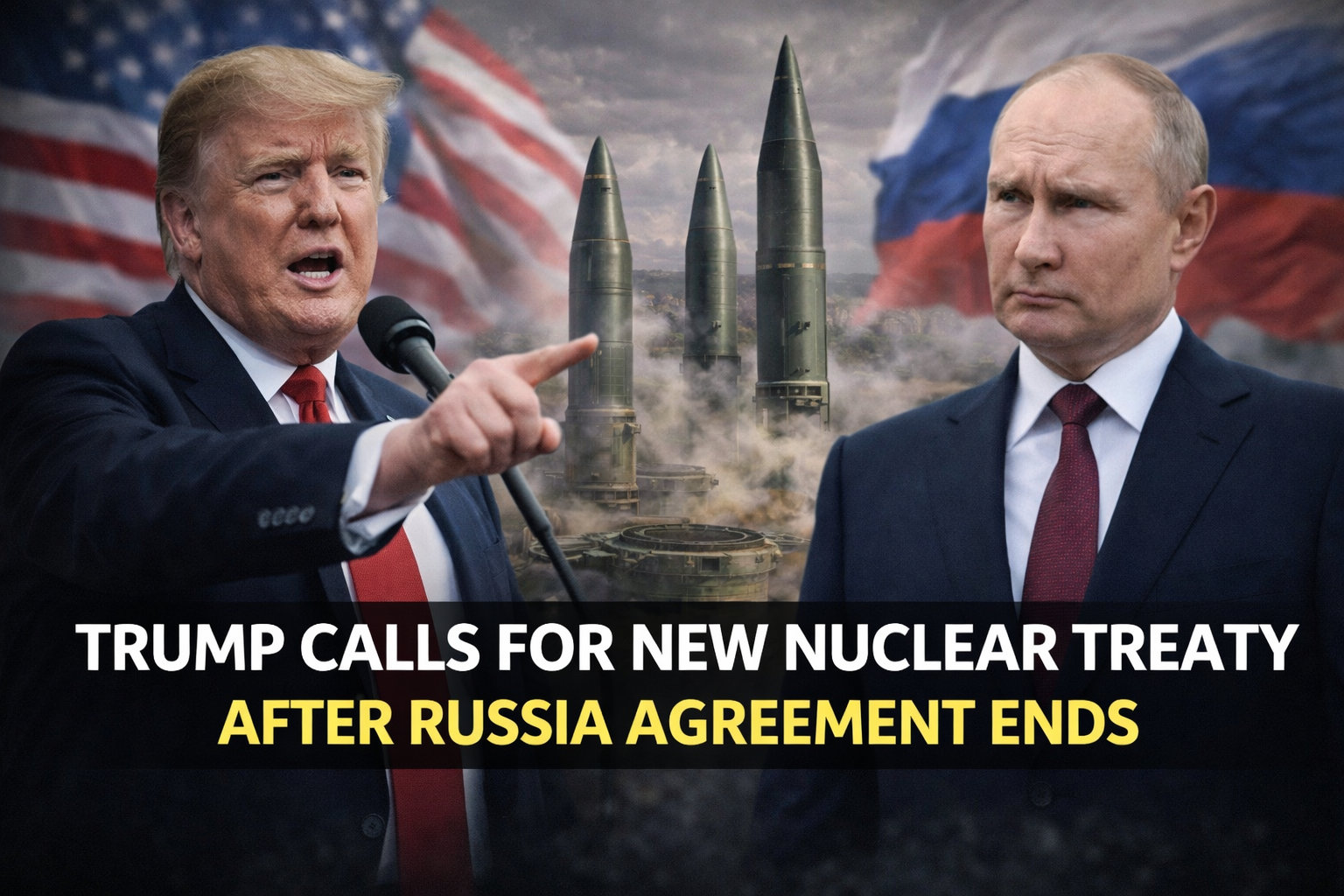
When nuclear treaties collapse, the consequences are never confined to diplomatic paperwork. They ripple through global security, military strategy, and public anxiety. That is why recent remarks by Donald Trump, urging the creation of a new nuclear arms treaty after the effective end of a major U.S.–Russia agreement, have drawn sharp international attention.
Trump’s statement comes at a moment when nuclear arms control — once a stabilising pillar of global order — is fraying.With Russia stepping away from long-standing commitments, the world now faces an uncomfortable question: what replaces the old rules when the guardrails disappear?
This is not just a policy debate among diplomats. It is about whether the world drifts back toward an era of unchecked nuclear competition — or finds a new framework to prevent it.
What Agreement Has Ended — and Why It Matters
For decades, nuclear arms control between Washington and Moscow rested on treaties designed to limit the number of deployed nuclear weapons and reduce the risk of catastrophic miscalculation. The most important of these in recent years was New START, which capped deployed strategic nuclear warheads and allowed for inspections.
Russia’s suspension and effective withdrawal from key aspects of this framework marked a historic turning point. Inspections halted. Transparency eroded. Trust collapsed.
In practical terms, this means:
- No verified limits on deployed strategic warheads
- No on-site inspections
- Less predictability between the world’s two largest nuclear powers
When Trump says the agreement has “ended,” he is reflecting a reality many security experts have been warning about for months: the nuclear rulebook is breaking down.
Trump’s Call for a New Treaty: What He’s Really Saying
In his remarks, Trump argued that the collapse of existing agreements makes a new treaty not just desirable, but necessary. His message was blunt — without constraints, nations will inevitably build more powerful weapons.
The core of Trump’s argument is simple:
- Nuclear arms races are dangerous and expensive
- Treaties, while imperfect, reduce the risk of war
- A new deal must reflect today’s realities, not Cold War assumptions
Interestingly, Trump has long criticised older arms treaties as outdated or unfair. During his presidency, he argued that agreements must include new technologies and additional powers, not just the U.S. and Russia.
Now, his renewed push suggests a recognition that no treaty at all may be worse than a flawed one.
Why the World Is Nervous Right Now
The end of a U.S.–Russia nuclear agreement doesn’t happen in a vacuum. It coincides with:
- The war in Ukraine
- Rising tensions between major powers
- Rapid advances in missile, cyber, and space technology
Without treaties, nuclear-armed states may feel fewer restraints on:
- Expanding warhead stockpiles
- Deploying new delivery systems
- Reducing transparency about capabilities
This increases the risk of miscalculation — the kind that history shows can spiral quickly.
That is why Trump’s comments resonate beyond U.S. domestic politics. Whether people agree with him or not, the concern he voices is widely shared in strategic circles.
A Shift in Tone From Trump?
Trump is often associated with skepticism toward international agreements. Yet his call for a new nuclear treaty highlights a pragmatic side of his worldview.
Rather than defending old frameworks, he appears to be arguing for:
- Renegotiation, not abandonment
- Stronger enforcement, not blind trust
- Broader participation, possibly involving China
This aligns with arguments Trump made while in office — that any future nuclear deal must reflect the multipolar world of the 21st century, not the bipolar standoff of the Cold War.
Whether this shift is driven by strategy, legacy, or political positioning is open to debate. But the message itself is notable.
The Russia Factor: Why Trust Is So Low
Any discussion of a new treaty inevitably runs into the same obstacle: trust.
Relations between Washington and Moscow are at their lowest point in decades. Russia’s suspension of arms control commitments has deepened skepticism in the West about whether agreements can be enforced at all.
From Russia’s perspective, officials argue that:
- Western sanctions undermine cooperation
- NATO expansion threatens strategic balance
- Existing treaties no longer serve Russian interests
This mutual suspicion makes negotiation extremely difficult — but also more necessary.
Can a New Treaty Actually Happen?
The idea of a new nuclear treaty sounds reasonable, but the path to one is steep.
Major challenges include:
- Verification mechanisms without inspections
- Inclusion of new weapons systems
- Whether other nuclear powers should be involved
- Domestic political resistance in all countries
Still, history shows that arms control agreements often emerge from periods of extreme tension — not harmony.
Trump’s call may not lead to immediate negotiations, but it adds political weight to an issue many leaders would rather avoid.
Why This Matters to Ordinary People
Nuclear treaties can feel distant from daily life, but their absence affects everyone.
Without arms control:
- Military spending rises
- Global instability increases
- The risk of catastrophic conflict grows
Treaties don’t eliminate nuclear weapons, but they reduce uncertainty — and uncertainty is what makes crises deadly.
When leaders talk about new frameworks, they are really talking about how close the world is willing to stand to the edge.
The Bigger Picture: A World Without Guardrails
The collapse of nuclear agreements reflects a broader breakdown in global cooperation. Trade rules, climate commitments, and security frameworks are all under strain.
Trump’s remarks highlight a paradox of modern geopolitics:
Even leaders skeptical of international institutions recognise the danger of having none at all.
A world without nuclear treaties is not a freer world — it is a more dangerous one.
Final Thoughts: Warning or Opportunity?
Trump urging a new nuclear treaty after Russia’s agreement ends should be seen less as a policy blueprint and more as a warning.The old system is failing, and something must replace it.
Whether that “something” becomes a new treaty, a temporary framework, or a prolonged period of uncertainty depends on political will — and global leadership.
For now, one thing is clear: the era of automatic nuclear stability is over. What comes next will shape global security for decades.