
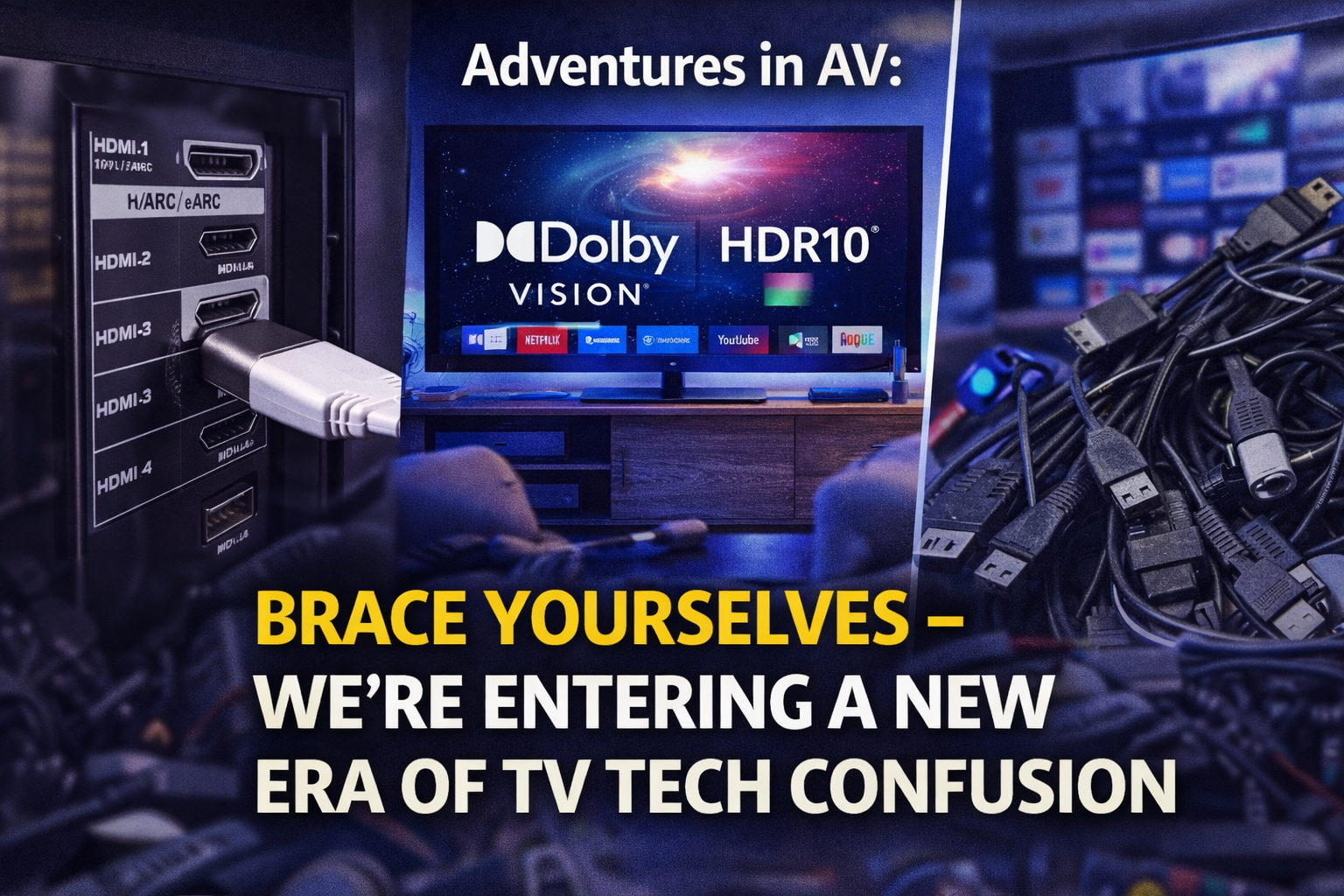
If you’ve bought a new TV recently, chances are the excitement didn’t last very long. Somewhere between unboxing the screen and plugging in your soundbar, you probably ran into a wall of unfamiliar terms: HDMI 2.1, eARC, QLED, Mini-LED, Dolby Vision IQ, HDR10+, VRR, ALLM — and that’s before opening the settings menu.
Welcome to the new era of TV tech confusion, where televisions are smarter, sharper, and more powerful than ever, yet somehow harder to understand.
This isn’t just you. Even tech-savvy users are scratching their heads.
TVs Are No Longer Just TVs
Once upon a time, choosing a TV was simple. You picked a size, checked the price, and maybe argued plasma versus LCD. Today, TVs are more like computers disguised as screens.
Modern TVs combine:
- Streaming platforms
- Gaming features
- Home theatre hubs
- Smart assistants
- AI-driven picture processing
Each upgrade brings benefits, but also layers of complexity. The TV is no longer a passive device — it’s the center of an entire entertainment ecosystem.
The HDMI Problem Nobody Warned You About
HDMI ports look identical, but they are not created equal. This single fact has become one of the biggest sources of confusion.
Some HDMI ports support:
- 4K at 60Hz
- Others support 4K at 120Hz
- Only one might support eARC
- Another might be limited to ARC
Plug your console or soundbar into the “wrong” port and suddenly features you paid for simply don’t work.
Manufacturers don’t help either. Labels like “HDMI 3 (eARC)” sound clear until you realize your gaming console also needs HDMI 2.1 bandwidth — and now you’re choosing which device gets priority.
HDR Wars: More Formats, More Confusion
HDR was supposed to improve picture quality. Instead, it introduced another battlefield.
You’ll now see TVs advertising:
- HDR10
- HDR10+
- Dolby Vision
- Dolby Vision IQ
- HLG
Not all TVs support all formats. Not all streaming apps use the same HDR. Some games support HDR differently than movies. And worst of all, your TV might technically support HDR — but not display it well.
For everyday users, the result is simple: Why does this movie look amazing on Netflix but dull on another app?
Smart TVs Aren’t Always That Smart
Smart TV software has improved, but fragmentation remains a problem. Different brands use different operating systems, each with strengths and weaknesses.
- Some apps arrive late or never
- Updates can slow down older models
- Ads are increasingly baked into menus
- Privacy settings are buried deep
Ironically, many people buy expensive smart TVs only to use an external streaming device because it feels simpler and faster.
Gaming Features Add Another Layer
For gamers, TVs now promise console-level performance with buzzwords like:
- Variable Refresh Rate (VRR)
- Auto Low Latency Mode (ALLM)
- 120Hz panels
- Game Optimizer modes
But here’s the catch: not all features work simultaneously. Some TVs disable local dimming in game mode. Others reduce picture quality to cut latency.
So gamers are left choosing between performance and visuals — on a screen that was marketed as delivering both.
Sound Is Still the Weakest Link
Despite razor-thin panels and stunning visuals, TV audio still disappoints. This pushes users toward soundbars and AV receivers — which introduces yet another maze of compatibility issues.
ARC vs eARC alone has confused millions. Add Dolby Atmos, DTS:X, passthrough limits, and suddenly setting up sound feels harder than assembling furniture.
You shouldn’t need a YouTube tutorial to hear dialogue clearly — yet here we are.
Why This Confusion Is Inevitable
The truth is, TV technology is evolving faster than user education. Brands race to outdo each other with features, assuming consumers will “figure it out later.”
But unlike smartphones, TVs:
- Stay in homes for years
- Interact with many devices
- Depend heavily on standards
When standards evolve faster than adoption, confusion becomes unavoidable.
What This Means for Buyers
We’re entering an era where buying a TV requires asking the right questions, not just looking at specs.
Smart buyers now consider:
- How many HDMI 2.1 ports are actually usable
- Whether the TV supports their preferred HDR format
- How long software updates last
- Whether gaming or movies matter more
The best TV on paper isn’t always the best TV for you.
The Silver Lining
Despite the confusion, the experience has never been better once things are set up correctly. Picture quality today surpasses what high-end cinemas offered a decade ago. Gaming on modern TVs feels transformative. Streaming content looks stunning.
The problem isn’t the technology — it’s how poorly it’s explained.
Final Thoughts
This new era of TV tech confusion isn’t going away. If anything, it will get more complex as AI processing, cloud gaming, and deeper ecosystem integration arrive.
The key is mindset. Don’t treat TVs as simple appliances anymore. They’re platforms — and like any platform, they demand a bit of learning.
Brace yourself, ask questions, and remember: if TV tech feels confusing, it’s not because you’re behind — it’s because the industry sprinted ahead.