
Introduction: When Water Becomes the Rarest Resource
In most parts of the world, turning on a tap is an everyday habit that barely registers in our minds. In Gaza, that simple action has become a daily struggle for survival. As the conflict drags on and diplomacy stalls, clean water — the most basic necessity of life — is slipping further out of reach for millions.
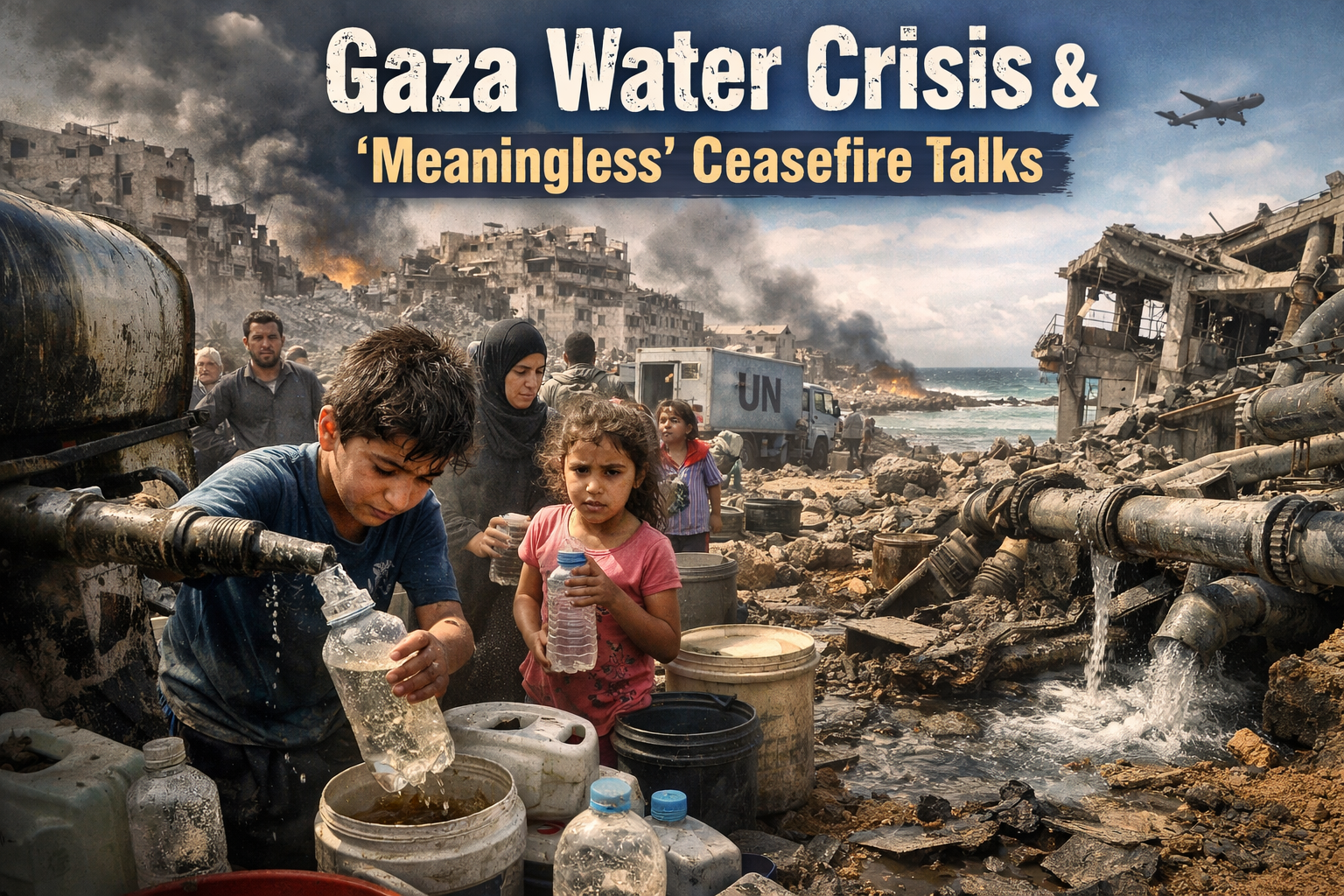
Recent updates from the region paint a bleak picture. Aid agencies warn that Gaza’s water systems are near collapse, while Hamas has dismissed ongoing ceasefire efforts as “meaningless,” arguing that conditions on the ground tell a very different story from what is discussed at negotiation tables. For ordinary civilians, the crisis is no longer about politics or statements — it is about whether there will be safe water to drink tomorrow.
This is not just a headline-driven tragedy. It is a slow, grinding humanitarian disaster that grows worse with each passing day.
Why Clean Water Is at the Heart of Gaza’s Crisis
Water has always been scarce in Gaza, even before the current conflict escalated. Years of blockade, overpopulation, and limited infrastructure investment had already strained the region’s water supply. But the ongoing fighting has pushed an already fragile system to the brink.
Large sections of Gaza’s water pipelines, desalination plants, and sewage treatment facilities have been damaged or destroyed. Fuel shortages have forced many remaining water pumps to shut down. In some neighborhoods, families survive on a few liters of water per person per day — far below international humanitarian standards.
For many residents, the only available water is salty, contaminated, or unsafe. Parents are forced to choose between giving their children dirty water or giving them none at all. Doctors report rising cases of dehydration, kidney problems, and waterborne diseases, particularly among children and the elderly.
From a human perspective, this crisis cuts deeper than statistics. Water is dignity. It is health. It is the difference between resilience and despair.
Ceasefire Talks vs. Reality on the Ground
On paper, ceasefire discussions are meant to reduce violence and allow humanitarian aid to flow freely. In reality, Gaza’s situation suggests a painful disconnect between diplomatic language and lived experience.
Hamas’s claim that the ceasefire is “meaningless” reflects growing frustration within Gaza. From their perspective, continued military operations, restricted aid access, and infrastructure damage undermine any promise of relief. While negotiators debate terms and timelines, civilians see little improvement in daily life.
Even during pauses in fighting, aid deliveries remain inconsistent. Water purification tablets, fuel for desalination plants, and repair materials often fail to reach those who need them most. Without sustained access and infrastructure repair, temporary truces do little to address the core of the crisis.
This gap between negotiation rooms and shattered streets is where humanitarian suffering quietly multiplies.
The Human Cost: Living Without Safe Water
Behind every update are real people adapting to impossible conditions.
Families reuse the same water for cooking, washing, and cleaning — not by choice, but by necessity. Children miss school not only because of insecurity, but because illness has become routine. Hospitals struggle to maintain hygiene standards, raising the risk of infection for patients already weakened by malnutrition and stress.
Women and children often bear the heaviest burden, walking long distances or waiting hours for water trucks that may or may not arrive. What should be a basic human right has turned into a daily gamble.
From a human lens, the water crisis is not just a side effect of war — it is one of its most cruel weapons.
International Response: Help That Isn’t Enough
The international community is not unaware of Gaza’s suffering. United Nations agencies, humanitarian organizations, and neighboring countries have repeatedly called for expanded aid access. Emergency water supplies and mobile desalination units have been proposed and, in some cases, deployed.
Yet these measures remain limited compared to the scale of the need. Aid workers warn that without a stable ceasefire and guaranteed access, humanitarian efforts are reduced to short-term fixes. You cannot rebuild water infrastructure under constant threat.
There is also growing concern that donor fatigue may set in, as crises elsewhere compete for attention. But for Gaza’s residents, the urgency does not fade — it intensifies.
Why Water Access Is a Political and Moral Issue
Water shortages in Gaza are not just a humanitarian concern; they are deeply political. Control over borders, fuel supplies, and infrastructure repair all shape who gets access to clean water and who does not.
At the same time, the issue transcends politics. International law recognizes access to clean water as a fundamental human right. When civilians are deprived of it, the consequences ripple across generations — affecting health, education, and social stability.
Ignoring Gaza’s water crisis today risks creating a long-term public health catastrophe tomorrow.
What Needs to Change for Real Relief
For the crisis to ease in a meaningful way, several steps are essential:
- Sustained Ceasefire: Temporary pauses are not enough. Long-term stability is required to repair and protect water infrastructure.
- Unrestricted Humanitarian Access: Water treatment supplies, fuel, and repair equipment must move freely and consistently.
- Infrastructure Rehabilitation: Emergency aid must be paired with rebuilding desalination plants and sewage systems.
- International Accountability: Global actors must ensure commitments translate into real improvements on the ground.
Without these steps, statements about peace will continue to ring hollow for those struggling to survive.
Conclusion: More Than Just a Crisis, a Test of Humanity
Gaza’s clean water crisis is a stark reminder that wars are not only fought with weapons — they are fought through deprivation. As ceasefire talks stall and rhetoric hardens, civilians remain trapped between politics and survival.
Calling a ceasefire “meaningless” may sound like a political statement, but in Gaza, it reflects a deeper truth: peace is not measured by words alone, but by whether people can drink clean water, wash their hands, and live with basic dignity.
Until that changes, the humanitarian emergency in Gaza will continue to grow — quietly, painfully, and largely unseen by those far from its broken taps