
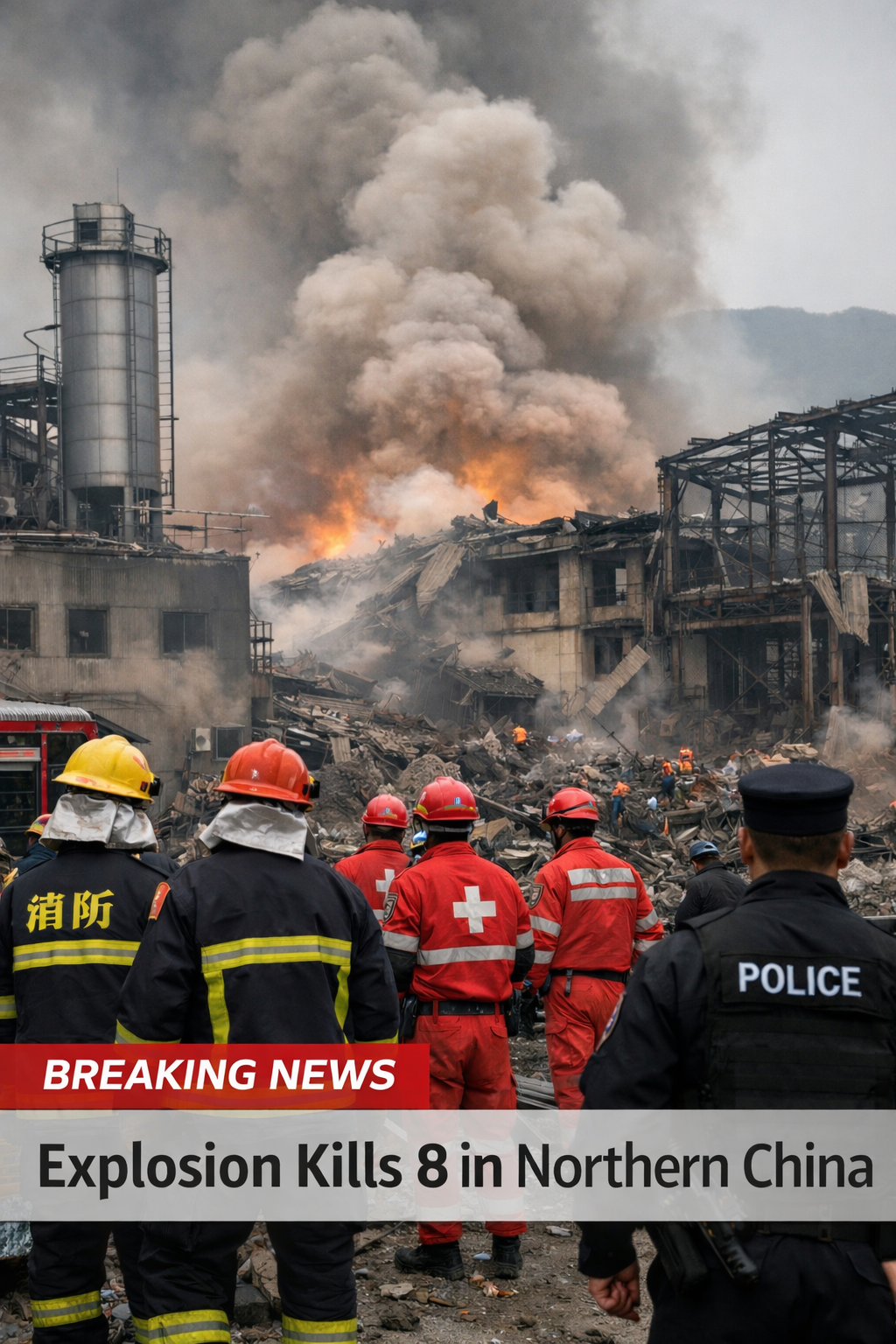
People living close to an industrial area in northern China’s Shanxi province say they knew instantly something had gone terribly wrong. Windows rattled. The air shook. Then came the smoke — thick, heavy, and rising fast.
By the time emergency crews reached the site, the damage was already done.
State media later confirmed that eight people were killed in the explosion, which occurred at a small industrial facility. The cause is still unknown, and officials say investigations are ongoing. For now, families are left grieving, and questions hang in the air.
What Happened at the Site
The explosion took place at a biotechnology-related factory in Shanxi, a province known for industry and manufacturing. According to early reports, the blast happened suddenly, giving workers little time to react.
Rescue teams arrived quickly. Firefighters worked to control the scene and prevent further explosions. Police blocked off the surrounding area. Medical teams searched for survivors.
But there were none.
Eight deaths were confirmed. Authorities have not released clear numbers on injuries, and details remain limited. That lack of information has only added to public unease.
A Familiar Silence After Tragedy
As with many industrial accidents in China, official statements were brief. There were no immediate explanations. No detailed timeline. Just confirmation of deaths and a promise of a “thorough investigation.”
For families of the victims, that is never enough.
In moments like these, people want answers — fast. What went wrong? Was it equipment failure? Human error? Poor safety practices? Or something else entirely?
So far, none of those questions have been answered.
Company Under Scrutiny
One thing authorities did move quickly on was accountability.
The company involved is reported to be small and relatively new, not a large state-owned enterprise. Local officials have detained the company’s legal representative while the investigation continues — a standard step in serious industrial accidents, but one that signals potential violations are being considered.
Investigators are expected to examine safety records, storage practices, staff training, and whether the company followed required regulations. Whether negligence played a role remains unclear.
What is clear is that small companies often face less scrutiny — and sometimes weaker enforcement — until something goes wrong.
Voices From Nearby Residents
Residents living close to the site say the explosion was frightening.
Some described hearing a sharp, violent bang, followed by a wave of pressure that made doors and windows shake. Others said they rushed outside, worried it was an earthquake or a gas blast.
Several people reported seeing smoke rising into the sky for hours afterward.
These accounts are important because they remind us that industrial accidents don’t just affect workers. They affect entire communities.
Not an Isolated Incident
For many in China, this tragedy feels painfully familiar.
Despite years of promises to improve workplace safety, industrial accidents continue to claim lives. Explosions, fires, chemical leaks, and mining disasters still occur, particularly in provinces with heavy industrial activity.
Shanxi itself has seen multiple serious incidents over the years. While safety standards have improved on paper, enforcement can be uneven — especially at the local level.
Each time a disaster happens, officials vow stricter checks. Each time, investigations are launched. And yet, similar stories keep appearing.
That repetition has led many to question whether lessons are truly being learned.
Why Industrial Safety Is Still a Problem
China’s economic growth has been fast — sometimes too fast for safety systems to keep up.
Smaller companies may struggle with costs and cut corners. Workers may not receive enough training. Safety equipment may not be properly maintained. Inspections may focus more on paperwork than real-world conditions.
In some cases, warnings are ignored until it’s too late.
The explosion in Shanxi raises uncomfortable questions. Were there signs of danger? Did anyone raise concerns before the blast? And if they did, were they taken seriously?
These are the questions investigators will need to answer.
Government Response and Public Trust
Chinese authorities have become more willing in recent years to punish those responsible for workplace accidents. Detentions, fines, and criminal charges are now more common than they once were.
Still, public trust depends on transparency.
People want to see investigation results made public. They want to know who is responsible and what changes will be made to prevent similar incidents.
Without that openness, official promises risk sounding hollow.
The Human Cost
Beyond policy debates and safety regulations, there is the human cost.
Eight workers lost their lives. Eight families are now dealing with grief that will not fade when headlines move on. Compensation may be offered, but it cannot replace a parent, a spouse, or a child.
For co-workers who survived, there may be trauma, fear, and uncertainty about returning to work.
These are the invisible consequences of industrial accidents — consequences that statistics rarely capture.
What Happens Next
Authorities say the investigation is ongoing, and more information will be released once findings are complete. That process may take weeks.
Until then, the factory site remains sealed, and scrutiny will likely extend to similar businesses in the region.
Whether this tragedy leads to lasting change or becomes just another entry in a long list of accidents remains to be seen.
Final Thought
The explosion in northern China is not just a local story. It is a reminder that economic progress means little without safety.
As long as workers continue to die in preventable accidents, questions will persist — not just about what happened, but about why it keeps happening.