
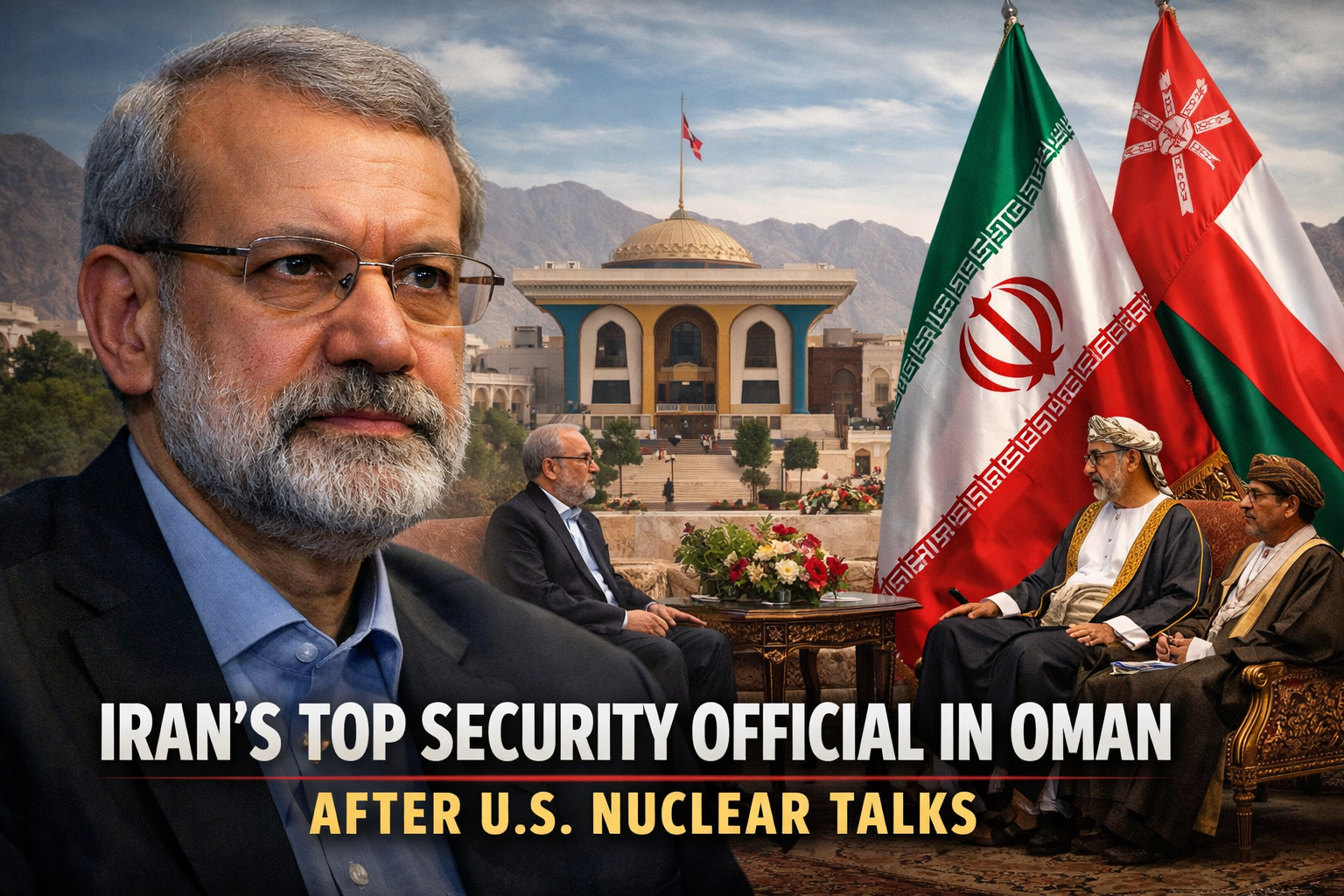
Muscat: Iran’s top security official has travelled to Oman just days after indirect nuclear talks between Tehran and Washington, underlining renewed — but cautious — diplomatic movement around Iran’s nuclear programme.
The visit, confirmed by multiple sources familiar with the matter, places Ali Larijani, a senior figure in Iran’s security establishment, in Muscat, where Oman recently hosted backchannel talks between Iranian and American representatives.
While no official statements have promised progress, the timing alone has drawn attention across diplomatic circles in the Middle East and beyond.
Why This Visit Is Significant
The arrival of a top security official — rather than a foreign ministry diplomat — is widely seen as a deliberate signal from Iran. It suggests that Tehran views the nuclear file not merely as a diplomatic issue, but as a core national security concern.
Iran and the United States remain deeply divided over sanctions relief, uranium enrichment levels, and long-term guarantees. Yet this visit shows that communication channels remain open, even as public rhetoric stays firm.
Iranian officials have repeatedly stressed that negotiations do not mean concessions. “Talks are a tool, not a goal,” one senior Iranian source said, reflecting Tehran’s broader strategy of patience over urgency.
What Happened in the US–Iran Nuclear Talks
The recent discussions in Oman were indirect, meaning Iranian and US officials did not meet face-to-face. Instead, messages were exchanged through Omani mediators — a method that has become standard when direct engagement is politically difficult.
The talks reportedly focused on:
- Assessing whether Washington is prepared to ease specific sanctions
- Clarifying Iran’s nuclear activities and future intentions
- Preventing further escalation amid rising regional tensions
Officials familiar with the talks describe them as exploratory, aimed more at testing seriousness than reaching immediate agreements.
Oman’s Role as a Trusted Mediator
Oman’s involvement is not new, but it remains critical.
The Gulf state has long maintained balanced relations with both Tehran and Washington, allowing it to act as a discreet intermediary during moments of crisis. From early nuclear discussions years ago to sensitive prisoner exchanges, Oman has consistently provided neutral ground.
For Muscat, hosting such talks reinforces its diplomatic identity: quiet, pragmatic, and focused on de-escalation rather than headlines.
Larijani’s meetings with Omani officials are expected to centre on feedback from the latest round of talks and whether further engagement is viable in the coming weeks.
Why Iran Chose a Security Figure
Sending a senior security official sends a layered message.
First, it tells mediators that Iran’s leadership is directly involved. Second, it lowers public expectations — security visits are less likely to produce flashy announcements than diplomatic summits. Third, it allows Iran to maintain strategic ambiguity.
If talks move forward, Tehran can gradually elevate engagement. If they stall, Iran can step back without appearing to have failed diplomatically.
This approach aligns with Iran’s broader negotiating posture: measured, controlled, and resistant to pressure.
The US Side of the Equation
For Washington, indirect talks offer flexibility.
The US wants to prevent Iran from advancing its nuclear capabilities further while avoiding a wider regional crisis. At the same time, any deal involving sanctions relief remains politically sensitive.
By working through Oman, the US can explore options quietly, adjust positions, and manage expectations — both internationally and at home.
Regional and Global Impact
The implications extend far beyond Tehran and Washington.
- Middle East stability: Any easing of tensions reduces the risk of miscalculation
- Energy markets: Sanctions shifts could affect global oil supplies
- Global diplomacy: The talks test whether quiet mediation still works in a polarized world
Analysts note that even limited dialogue can help prevent sudden escalations.
What Comes Next
No immediate breakthroughs are expected. Instead, diplomats anticipate:
- Continued indirect exchanges
- Small confidence-building steps
- Careful avoidance of public ultimatums
Whether these talks evolve into formal negotiations will depend on political calculations in both capitals.
The Bottom Line
Iran’s decision to send its top security official to Oman is not a dramatic turn — and that is precisely the point.
In a region often dominated by loud threats and sharp statements, this visit reflects a different approach: quiet diplomacy, cautious engagement, and strategic patience.