
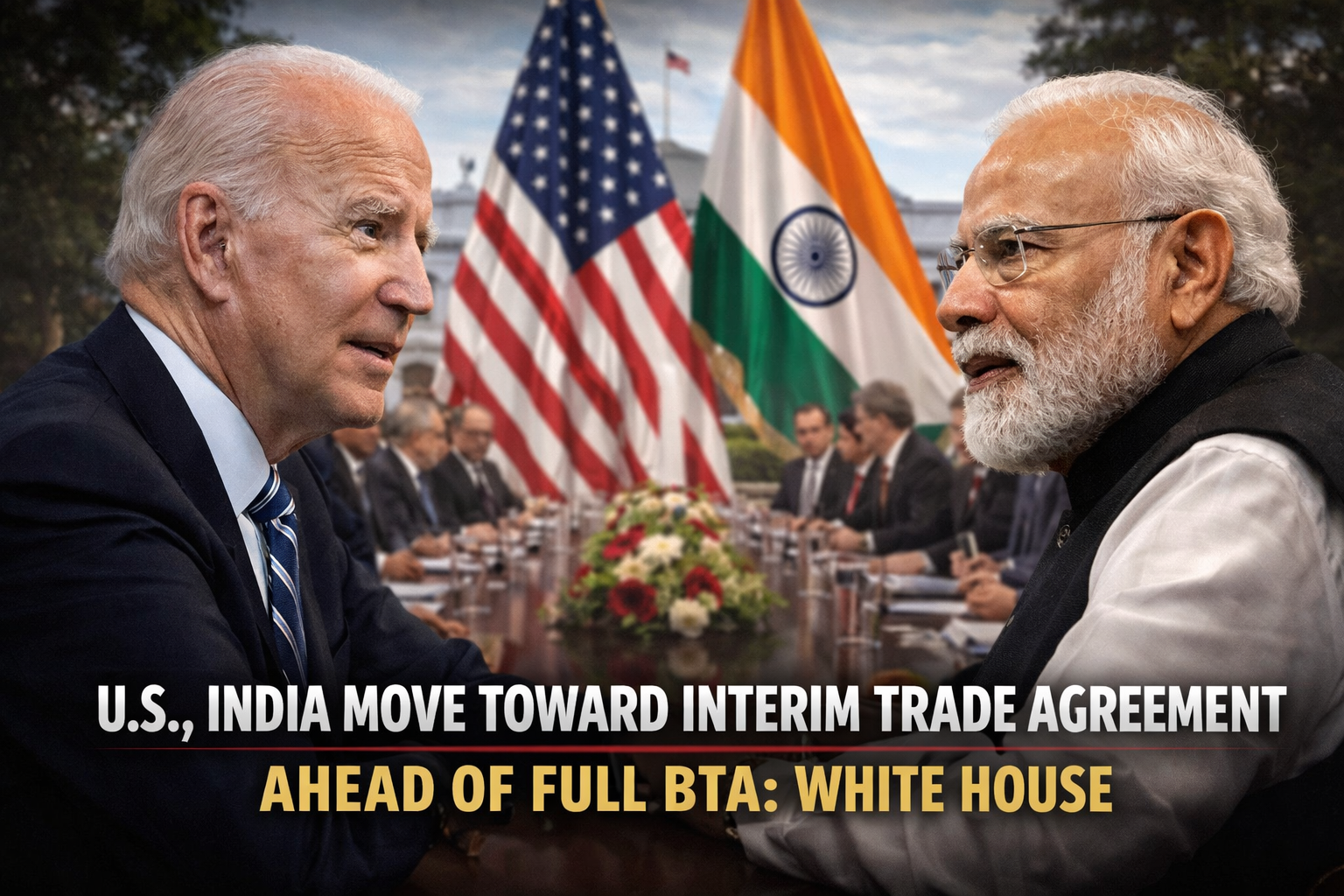
The United States and India have agreed to work toward finalising an interim trade agreement, keeping in view the larger goal of concluding a comprehensive Bilateral Trade Agreement (BTA), according to a fact sheet released by the White House.
The announcement signals fresh momentum in India–US economic relations at a time when both countries are looking to strengthen strategic partnerships, diversify supply chains, and reduce friction over long-standing trade disputes.
While the proposed interim agreement is not expected to resolve every outstanding issue, it is widely seen as a confidence-building step — a way to unlock progress on easier areas while negotiations continue on a broader, more ambitious trade pact.
What the White House Fact Sheet Says
According to the fact sheet, United States and India have agreed to intensify discussions on trade and market access, with a focus on achieving near-term results through an interim framework.
The document highlights:
- Ongoing efforts to address tariff and non-tariff barriers
- Cooperation on supply chains, critical technologies, and manufacturing
- A shared intent to eventually conclude a full Bilateral Trade Agreement
Importantly, the White House framed the talks as part of a long-term economic partnership, rather than a one-off negotiation driven by short-term pressures.
Why an Interim Agreement Matters
Trade negotiations between India and the US have historically been complex. Both economies are large, diverse, and politically sensitive when it comes to market access.
A full BTA can take years to negotiate. An interim agreement, however, allows both sides to:
- Resolve select, mutually beneficial issues
- Build trust through early deliverables
- Reduce uncertainty for businesses and investors
For India, this could mean improved access for certain exports, smoother regulatory pathways, and clarity on tariffs. For the US, it may open doors for agricultural goods, digital services, and high-value manufacturing exports.
The Bigger Trade Relationship
India and the US already share a strong trade relationship. Bilateral trade in goods and services has grown steadily over the past decade, making the US one of India’s largest trading partners.
Yet friction points remain:
- Tariffs on agricultural products
- Differences over digital trade and data policies
- Market access issues for medical devices and dairy products
Rather than allowing these disputes to stall the entire relationship, both governments now appear willing to segment negotiations, tackling achievable goals first while keeping broader ambitions intact.
Strategic Context Beyond Trade
The renewed push for a trade agreement is not happening in isolation.
India and the US are deepening cooperation across defence, technology, clean energy, and geopolitics. Economic alignment is increasingly seen as a pillar of this broader partnership.
From Washington’s perspective, strengthening trade ties with India helps diversify supply chains away from overdependence on a single region. From New Delhi’s standpoint, deeper access to US markets supports domestic manufacturing, exports, and job creation.
This strategic convergence adds urgency — but also caution — to trade talks.
What an Interim Deal Could Include
While officials have not released detailed negotiating texts, trade experts suggest an interim agreement could focus on:
- Select tariff reductions
- Regulatory cooperation in specific sectors
- Improved customs and trade facilitation measures
- Dispute resolution mechanisms for limited areas
Crucially, such a deal would likely avoid politically sensitive sectors in its first phase, leaving them for later BTA negotiations.
Challenges Ahead
Despite positive signals, challenges remain.
Trade negotiations often run into domestic political constraints, especially in election-sensitive environments. Both governments must balance economic gains with concerns from farmers, small businesses, and domestic industries.
There is also the question of pace. Businesses on both sides are eager for clarity, but negotiators must ensure that speed does not come at the cost of durability.
What Happens Next
Trade officials from India and the US are expected to hold further rounds of discussions in the coming months. If progress is made, the interim agreement could be announced as a milestone achievement, paving the way for deeper negotiations on the full BTA.
Even if timelines stretch, the message from the White House fact sheet is clear: dialogue is active, intentions are aligned, and momentum is building.
The Bottom Line
The decision by the US and India to work toward an interim trade agreement reflects a pragmatic approach to a complex relationship.
Rather than waiting years for a perfect deal, both sides are choosing incremental progress — small steps that could eventually lead to a comprehensive Bilateral Trade Agreement.
In today’s fragmented global economy, that approach may prove not only realistic, but necessary.