
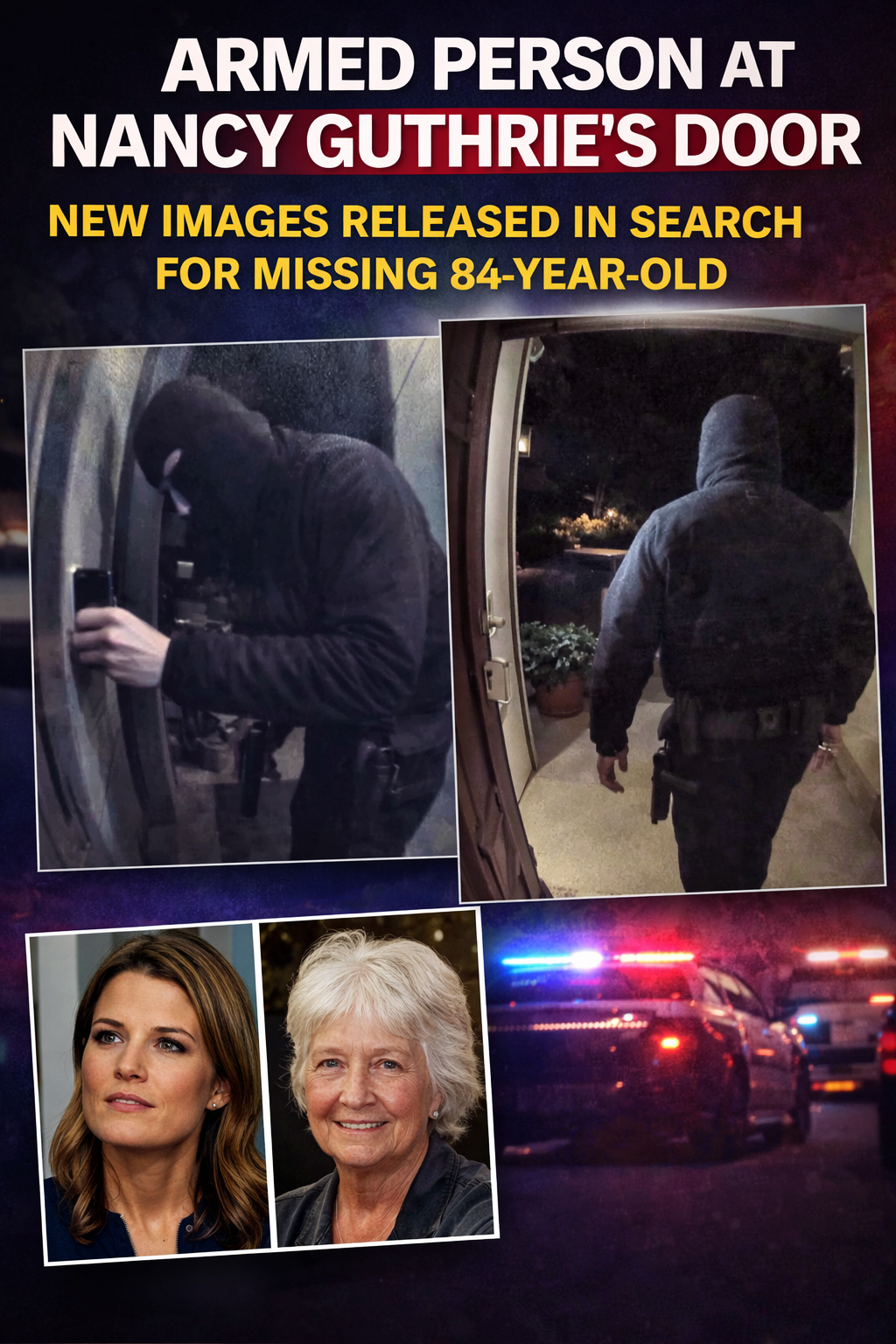
When law enforcement releases pictures in a missing-person investigation, it usually means two things: the case has turned urgent, and investigators believe the public might hold the missing puzzle piece. That’s the feeling around the disappearance of Nancy Guthrie, the 84-year-old mother of U.S. TV journalist Savannah Guthrie, after U.S. authorities published surveillance images and short video clips showing a masked person at her front door—an individual officials describe as “armed.”
This is not just another “keep an eye out” bulletin. The images appear to capture a deliberate attempt to deal with the home’s camera system before Nancy vanished, which is why the footage has landed like a jolt for both investigators and the public watching closely.
What the released images show — and why it matters
According to reporting and statements referenced by U.S. outlets, the released material comes from a doorbell-style camera and shows a masked individual at the entrance of Nancy Guthrie’s home in Tucson, Arizona. In at least one clip, the person appears to approach the camera, handle it, and attempt to block the lens—behavior that suggests planning rather than an accidental appearance on someone’s porch.
Authorities have described the person as armed, and some reporting notes what appears to be a weapon or weapon-related gear visible near the individual’s waist.
That detail changes the entire tone of the investigation. A masked person is concerning. A masked person who seems to be armed and focused on disabling cameras points investigators toward a more serious scenario.
The timeline investigators are piecing together
The disappearance itself dates to the very end of January and the early hours of February 1, based on what authorities have publicly outlined so far. Nancy Guthrie was last seen January 31, and investigators believe she may have been taken in the early hours of February 1.
Reuters reported that the person in the video was captured at the door in the early hours, shortly before Nancy was presumed abducted, and that the footage represents a major break in a case that had not publicly shown many leads.
There are also technical details that investigators are treating as important breadcrumbs. Reuters noted Nancy’s pacemaker disconnected from her phone around the time of the incident—one more timestamp that helps narrow the window of what happened and when.
“Recovered” footage: how did authorities get it?
One reason this case has drawn so much attention is that the surveillance material wasn’t initially available in the way people might expect. CBS News reported that authorities recovered images from “residual data” and that investigators worked with the camera provider to retrieve what they could from backend systems.
That matters because it suggests the suspect may have tried to defeat the camera system—yet investigators still managed to pull something usable. If you’re looking for a small bit of hope inside a grim story, this is it: sometimes the evidence people try hardest to erase ends up being exactly what identifies them.
Signs of a struggle and what investigators have disclosed
Officials have shared that blood found at the scene was confirmed to be Nancy Guthrie’s. Reuters described this as DNA-confirmed blood, a detail that has increased concern and urgency.
Authorities have not publicly said exactly what happened to her (and responsible outlets avoid speculating). But the confirmation of her blood at the home, combined with the door footage, is why investigators appear to be treating the case as a serious criminal matter rather than a routine missing-person report.
Ransom notes and the “proof of life” gap
Another reason the story keeps growing is the report of ransom demands. Entertainment Weekly reported that two Arizona news stations received a ransom note demanding millions of dollars in Bitcoin, and that later messages allegedly increased the amount.
At the same time, Reuters reported that despite ransom notes, investigators have not seen proof of life publicly confirmed.
That combination—ransom demands without proof—creates a hard reality for families and investigators. It can indicate opportunists jumping into a headline case, or it can indicate a real criminal effort. Either way, it complicates everything.
A person detained for questioning
In the hours around the release of images, authorities also detained a person for questioning, according to Reuters and other outlets. Reuters reported the detention happened during a traffic stop near Tucson, followed by a search of a property near Rio Rico, close to the U.S.-Mexico border.
CBS News also reported that a person of interest was detained, while noting it wasn’t immediately clear if that person is the same as the figure seen in the video.
This is an important point: “detained for questioning” is not the same as charged. Investigators often detain people to verify alibis, compare physical descriptions, or follow a lead that needs urgent checking. Still, it signals movement—something the public had been waiting for.
The family’s public plea and the emotional center of the story
It’s easy for internet discussion to turn a real case into a “mystery story.” But the center of this is a family trying to bring an elderly mother home.
Reuters reported that Savannah Guthrie and her family have made emotional appeals, expressing hope that Nancy is still alive and asking for help.
People respond strongly to these cases when they can imagine their own family in the same situation. An older parent living alone. A familiar front porch. A night that should have been ordinary.
And then a camera catches someone who shouldn’t be there.
What happens next — and what the public can do (safely)
At this stage, investigators typically do a few things at once:
- Expand the camera net: asking neighbors for footage and checking traffic cameras
- Rebuild the suspect path: identifying vehicles, movement patterns, and timing
- Push public identification: releasing stills, clothing details, and clips so someone recognizes the person
- Verify tips quickly: because early tips are often the most useful
People should not try to identify or confront anyone themselves. If someone believes they recognize the individual, the safest move is to contact law enforcement through official tip lines referenced in public releases.
Why this release could be a turning point
The biggest value of this footage is not just what it shows—it’s what it might trigger.
A coworker recognizes a backpack.
A neighbor remembers someone walking oddly.
A store clerk recalls the same gloves.
A family member sees the posture and says, “That looks like him.”
That’s how cases break open. Not always through one genius clue, but through a hundred small realizations that finally click into place.
For now, the public story is still unfinished. The investigation is active, and new details may emerge quickly. But the release of images of an armed, masked person at Nancy Guthrie’s door has already shifted the case into a new phase—one where authorities are clearly asking the wider public to help put a name to a face.