
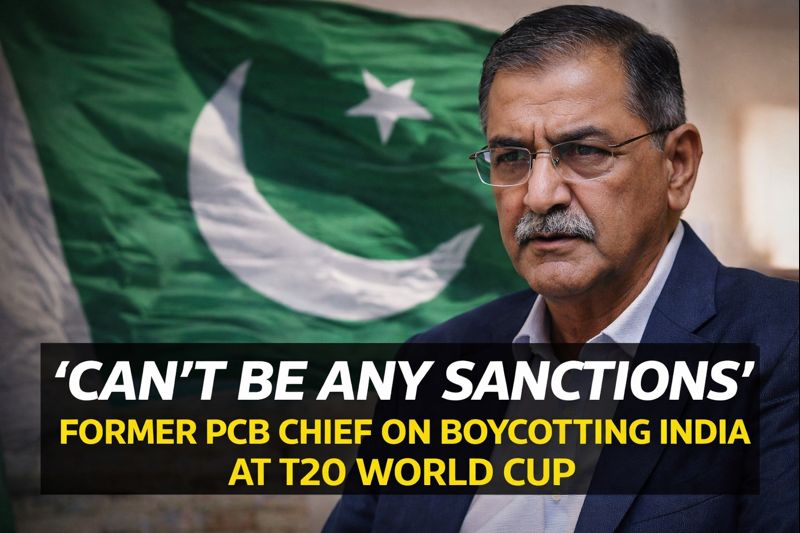
Few rivalries in world cricket carry as much history, emotion, and political baggage as India versus Pakistan. Every global tournament brings the same questions back to the surface, and the upcoming T20 World Cup is no different. Once again, speculation over whether Pakistan could boycott a match against India has triggered debate far beyond the boundary ropes.
Adding to that conversation, a former chairman of the Pakistan Cricket Board (PCB) has stated plainly that the International Cricket Council (ICC) would have no authority to sanction Pakistan if such a boycott were to happen. His reasoning is rooted not in emotion or rivalry, but in how international cricket governance actually works.
According to the former PCB chief, the ICC is not designed to act as a disciplinary body when political or security considerations affect participation. “There can’t be any sanctions,” he said, pointing out that the ICC constitution does not compel a member board to play a specific opponent if government clearance or security approval is not available.
This argument may frustrate fans who see cricket purely as a sport, but it reflects a long-standing reality of international cricket.
Why ICC’s Powers Are Limited
The ICC governs tournaments, sets playing conditions, and ensures member boards follow agreed regulations. What it does not do — at least in practice — is override national governments. Cricket boards operate within their domestic political systems, and when governments step in, the ICC has traditionally taken a cautious approach.
India–Pakistan cricket history offers several examples. Bilateral series between the two countries have been suspended for years at a time, often without formal explanation beyond “government advice.” Neither board has ever faced ICC sanctions for these decisions. That precedent matters.
The former PCB chief argues that even in ICC events, boards can cite extraordinary circumstances. Security concerns, diplomatic tensions, or official advisories are all factors the ICC tends to respect. Penalising a board for complying with its government would set a precedent the ICC has consistently avoided.
Political Reality vs Sporting Idealism
From a fan’s perspective, this situation is deeply unsatisfying. India–Pakistan matches are among the biggest draws in world cricket. They bring massive television audiences, packed stadiums, and commercial windfalls. Sponsors and broadcasters plan entire campaigns around these fixtures.
But international cricket does not operate in a political vacuum.
When relations between the two countries deteriorate, cricket is often the first casualty. Boards may publicly express willingness to play, but behind the scenes, approvals matter more than intent. The former PCB chief’s comments highlight this uncomfortable truth: cricket boards do not always control their own schedules.
Would There Be Any Consequences at All?
While the former PCB chief insists there can be no formal sanctions, that does not mean a boycott would come without cost. The consequences would simply be indirect rather than disciplinary.
Tournament points, net run rate implications, and match forfeitures could affect standings. The ICC would also face logistical headaches, including scheduling gaps and broadcast adjustments. Fans would react strongly, and commercial partners would not be pleased.
In other words, Pakistan may not be “punished,” but the fallout would still be significant.
The former PCB chief acknowledged this reality, noting that sporting consequences are unavoidable even if legal sanctions are not. A team choosing not to play a scheduled match would still have to accept whatever tournament rules apply to non-participation.
ICC’s Delicate Balancing Act
For the ICC, situations like this are a nightmare scenario. On one hand, it wants to protect the integrity of its tournaments. On the other, it cannot afford to alienate powerful member boards or appear to interfere in sovereign decisions.
Historically, the ICC has leaned toward negotiation rather than confrontation. Quiet discussions, schedule adjustments, and behind-the-scenes compromises are preferred over public penalties. This approach may look weak to critics, but it has helped the ICC avoid deeper political conflicts.
The former PCB chief’s comments suggest that this approach is unlikely to change anytime soon.
Not a New Problem
This is not the first time the possibility of a boycott has surfaced, and it almost certainly won’t be the last. Cricket between India and Pakistan has always mirrored the broader state of relations between the two countries.
What changes is the context. In some eras, limited engagement was possible under neutral venues. In others, even that proved difficult. The ICC has adapted each time, often by accepting the limits of its authority.
Those expecting a strict enforcement mechanism may be misunderstanding what the ICC was designed to do.
Fans Caught in the Middle
Perhaps the biggest losers in these situations are fans. Millions tune in hoping to watch high-quality cricket, only to find that political realities have once again intervened. The frustration is understandable, but the solution is not straightforward.
The former PCB chief’s blunt assessment — that sanctions are not possible — may sound unsatisfactory, but it reflects how international sport operates when national interests are involved.
Conclusion
The statement from the former PCB chairman cuts through much of the speculation surrounding a potential India–Pakistan clash at the T20 World Cup. His position is clear: the ICC does not have the legal or practical authority to sanction Pakistan for boycotting India if the decision is driven by political or security considerations.
That does not mean the situation would be consequence-free. Sporting, commercial, and reputational costs would still follow. But formal punishment, in the sense many fans imagine, is unlikely.
As with many things involving India–Pakistan cricket, the final outcome may depend less on cricketing logic and more on forces well beyond the pitch. Until those broader issues change, the game will continue to reflect the reality around it.