
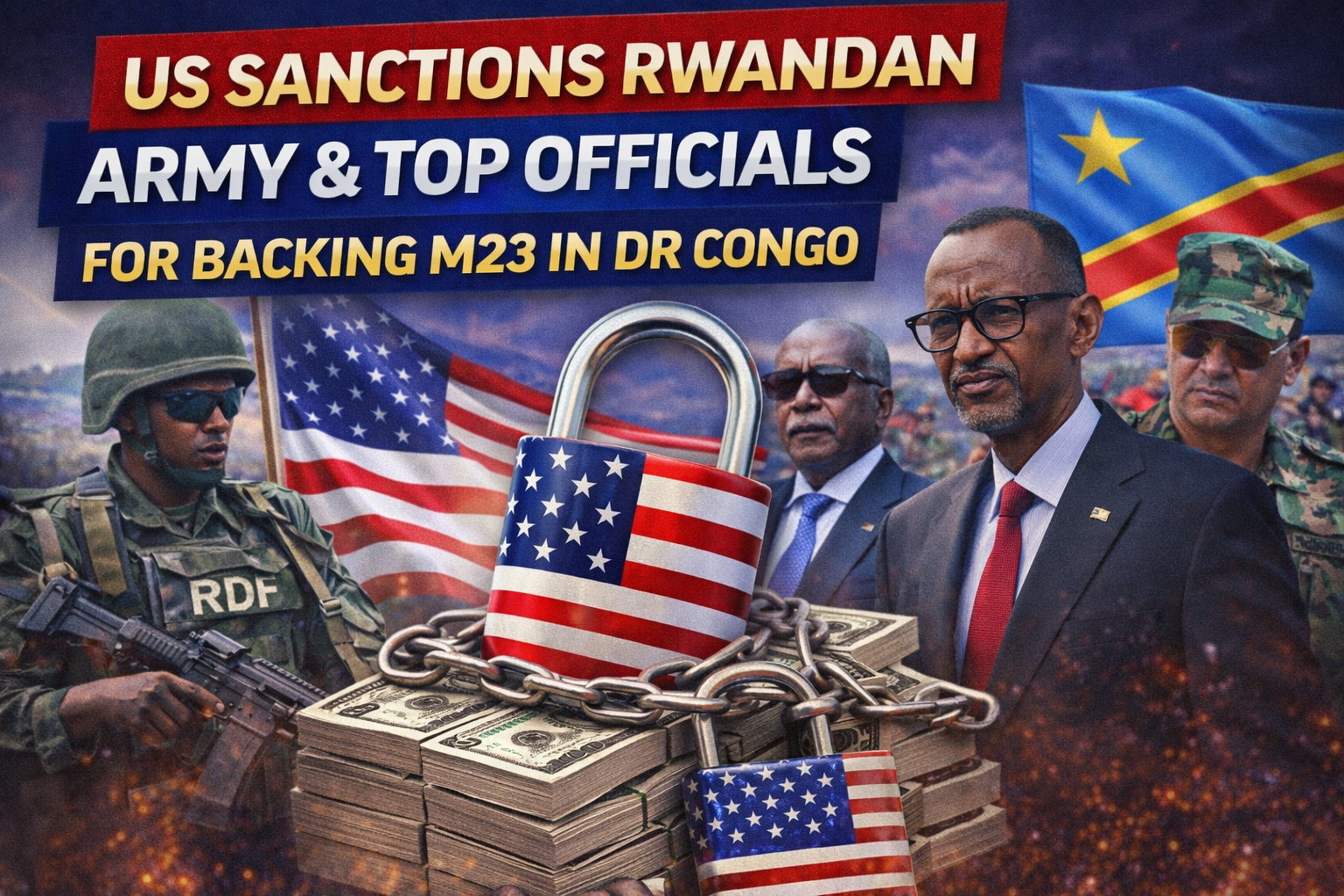
The United States has moved to sanction members of Rwanda’s military leadership over claims that Kigali has been backing the M23 rebel group in eastern Democratic Republic of the Congo.
It’s a serious step. And it didn’t come out of nowhere.
Accusations about Rwanda’s role in the conflict have been floating around for years. This time, Washington decided to act on them.
What Actually Changed?
Sanctions don’t mean troops or dramatic diplomatic breakdowns. They’re quieter than that.
In practical terms, the named individuals face asset freezes in the U.S., possible travel restrictions, and limits on financial dealings involving American institutions.
It’s not loud. But it’s pointed.
The message is clear: the U.S. believes certain Rwandan officials have played a role — directly or indirectly — in supporting M23 operations in eastern Congo.
Why This Conflict Keeps Coming Back
Eastern Congo has been unstable for decades. Armed groups rise, splinter, regroup. M23 is one of the more visible ones.
The region is rich in minerals. That alone makes everything more complicated.
Congo has repeatedly accused Rwanda of backing M23. Rwanda denies it. The argument isn’t new. What’s different now is that Washington has put names on paper and consequences behind them.
That changes the tone.
Rwanda’s Position
Kigali has rejected these accusations before and is doing so again.
Rwandan officials argue that they face cross-border security concerns and say they do not support rebel violence inside Congo.
From their point of view, the sanctions are unfair and risk making diplomacy harder.
And that’s the tricky part — sanctions are meant to push behaviour. But sometimes they harden positions instead.
Congo Sees It Differently
Kinshasa, on the other hand, views the move as overdue.
Congo’s government has long said that outside interference fuels instability in its eastern provinces. For them, U.S. sanctions feel like international validation of what they’ve been arguing.
But even Congolese officials know this won’t magically stop fighting.
The situation on the ground is layered. Armed groups don’t disappear because of foreign asset freezes.
The Human Side
Lost in the diplomatic language are the people actually living through this.
Families displaced again. Markets shut down. Schools operating intermittently. Aid agencies stretched thin.
Sanctions target leadership. Civilians deal with consequences.
That gap has existed in this conflict for years.
Why Now?
Timing always matters.
Violence tied to M23 has intensified again in recent months. Diplomatic efforts haven’t delivered much progress. International patience appears thinner.
Sanctions are often a sign that quiet conversations haven’t produced the results expected.
The U.S. seems to be saying: enough.
What Happens Next?
Hard to say.
Sanctions can escalate. They can also quietly fade if negotiations improve. Other countries might follow the U.S. lead. Or they might wait.
Much depends on what Rwanda does next — and how regional talks unfold.
Eastern Congo’s conflicts rarely move in straight lines. Pressure builds. Talks happen. Fighting pauses. Then something triggers it again.
It’s cyclical.
The Bigger Reality
This isn’t just about Rwanda and Congo.
It’s about how global powers choose to respond to regional conflicts. Sanctions have become the default tool — strong enough to signal disapproval, but short of direct intervention.
Sometimes they work. Sometimes they don’t.
What they always do, though, is raise the stakes.
Final Thought
The U.S. decision won’t end the conflict overnight.
But it adds weight to a long-running dispute that refuses to fade.
Whether that weight pushes leaders toward compromise — or deeper confrontation — is something the region will find out soon enough.
For now, the diplomatic temperature just went up.